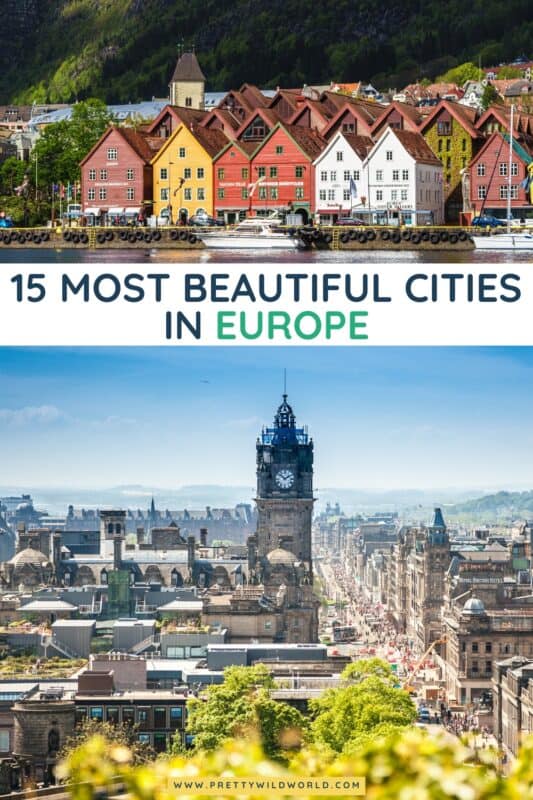
Quick Answer: The most beautiful cities in Europe sort by aesthetic category. Pastel and colorful: Lisbon, Burano, Cinque Terre, Reykjavík, Copenhagen’s Nyhavn. Gothic-medieval: Bruges, Prague, Tallinn, Cesky Krumlov, Edinburgh. Coastal-romantic: Dubrovnik, Hvar, Mykonos, Positano, Stockholm’s Gamla Stan. Modern-design: Copenhagen, Helsinki, Rotterdam, Bilbao. Renaissance and classical: Florence, Rome, Vienna, Salzburg, Granada. Pick the aesthetic that draws you first and the city follows.
Last updated: May 2026 · Prices and opening hours verified May 2026.
Step out of any guesthouse in Český Krumlov on a first morning and the sequence is always the same. The cobblestoned street curves, the painted castle tower appears against the morning sky, the Vltava River bends around the base of the old town, and the whole composition arrives whole. Take the photograph, walk twenty metres, find the next photograph, repeat until your phone is full and your coffee has gone cold. The town is small enough that the visual content arrives faster than you can process it. Maybe a dozen places on this continent operate at that density of beauty per minute walked. They earn the label more honestly than the famous capitals where the beauty is real but spread thin across many more kilometres.
The beautiful-city question doesn’t resolve to one answer. It resolves to five, because European cities consistently deliver at least five distinct aesthetics, and which one lands depends on personal taste, the season, and what kind of photograph you want to come home with. Pastel-painted street scenes hit differently from gothic spires. Coastal Mediterranean light reads nothing like the formal gardens of Renaissance Italy. Sorting by aesthetic first narrows the shortlist from forty cities to maybe ten.
Five categories follow, each holding 5-7 cities or towns that share a specific visual character. For the country-level version of the question, the most beautiful countries in Europe guide handles the bigger picture. For the broader city-break question that includes food, culture, and walkability, the best cities in Europe guide handles the wider angle.
Photography Gear for Beautiful European Cities
Phone photos do most of the work these days, but the difference between coming home with a camera roll of fine snaps and coming home with images that hold up printed at twelve inches usually comes down to a few small pieces of kit. The list below is what consistently turns up in the bags of travellers who post the polished version.


Pastel and Colorful Cities: The Painted-Street Aesthetic
Bold paint on building facades hits the phone camera the hardest. Cities that lean fully into colour deliver immediate photographic reward even at noon, and the palette tends to carry the photograph regardless of the photographer’s skill level. Six places below run the strongest version.
Lisbon, Portugal
Yellow trams climbing through canyons of pink and sage and terracotta houses, azulejo tiles catching the afternoon sun off the Tagus, the smell of grilled sardines drifting up from a tasca two streets below. The historic neighbourhoods (Alfama, Bairro Alto, Mouraria) layer palettes of buttercup yellow, dusty pink, jade green, and tile-fronted whitewash that have weathered just enough to look painted by hand. The Atlantic light from the river side has a warmth that inland Mediterranean cities can’t quite manage. Tram 28 threads the strongest colour sequences. Pair it with a Sintra day trip (the Pena Palace itself is painted red, yellow, and blue against the surrounding forest) for the deeper version. The Portugal travel guide handles the country.
Burano, Italy
Forty minutes by vaporetto from San Marco, every house painted in a different bold colour, tradition holding that fishermen needed to spot their own home from the lagoon in the fog. The result is the most concentrated colourful-street experience in Europe, packed into a few hundred metres of canal-side lanes around 2,400 residents. Day-trip traffic builds heavily after eleven; the first vaporetto out at eight in the morning puts you on streets with almost no one else holding a camera. Lace-making is the island’s traditional craft, and the campanile of San Martino tilts visibly enough to make a postcard joke of itself.
Cinque Terre villages (Italy)
Five villages pinned to vertical limestone cliffs above the Ligurian Sea, every house painted in candy colours that locals legally can’t change without permission from the regional authority. The clifftop path between Manarola and Riomaggiore catches the most-photographed Italian coastal scene of the past decade; Vernazza’s harbour with its medieval tower is the other postcard. Monterosso, Corniglia, and Riomaggiore complete the chain, connected by regional train, summer ferry, and the Sentiero Azzurro coastal trail. Visit May-June or September; July and August bring the kind of crowd that turns the trail into a single-file shuffle. The Italy travel guide covers the country.
Reykjavík, Iceland
Corrugated-iron houses painted primary red and cobalt and lemon yellow line the downtown blocks under a sky that swings from grey to gold to green-aurora across a single evening. The Hallgrímskirkja church on the hill anchors the skyline like a basalt-column rocket; the harbour area carries scale street-art murals worth a slow afternoon walk. Aurora season layers the green overhead from October through March. Midnight sun runs the opposite trick from late May through July, when the colours sit in 24-hour daylight that flattens nothing. The whole colourful district operates at a fraction of Lisbon’s scale, with completely different light. The Iceland travel guide handles the country.
Copenhagen’s Nyhavn (Denmark)
A canal lined with gabled merchant houses painted mustard, terracotta, brick red, soft blue, and ochre, wooden sailing boats moored along its length, the Scandinavian sky moving fast overhead. One of the strongest single-frame compositions in any northern European city, and the most photographed scene in the capital by a wide margin. The wider Copenhagen runs a contemporary-design aesthetic (the section further down covers it), but this particular waterfront belongs squarely in the colourful category. First-light visits or late autumn produce the best version; midday in July packs the cobblestones edge to edge. The Denmark travel guide handles the country.
Procida, Italy
Smaller and far less famous than Capri or Ischia, the third island in the Bay of Naples carries the kind of harbour scene that postcards have been trying to imitate for a century. The Marina Corricella holds a stacked row of pastel pink, ochre, and shrimp-coral houses cascading down to a small working fishing port; the visual density rivals Burano without the day-tripper crush. The 2022 Italian Capital of Culture designation lifted visibility slightly, but visitor numbers still run a fraction of Capri’s. Reachable as a day trip from Naples or as a 2-night base for the slow version.
Gothic and Medieval Cities: The Spires-and-Cobblestones Aesthetic
A different visual register entirely. Vertical spires, stone walls, cobblestoned streets that have been worn glossy by six centuries of feet, a darker palette that works as well in winter mist as it does in summer light. These cities photograph well on grey days, which is half the year in northern Europe.
Bruges, Belgium
Step lights and stepped gables reflecting in canals so still they double the city, swan paddling under a stone bridge, the Belfry tower bonging the hour with the same notes it has bonged since 1300. The most consistently photographable medieval centre in Europe runs roughly two square kilometres around the Markt square, and every corner of it photographs the way it looks in nineteenth-century engravings. The “Venice of the North” tagline is earned. Autumn and winter deliver the strongest medieval mood (low mist on the canals, low sun on the brick). Summer crowds overwhelm the small streets by ten in the morning.
Prague, Czech Republic
The highest density of medieval-baroque architecture in any major European capital, because the city escaped most of the WWII bombing that flattened equivalent districts elsewhere. The Old Town Square with its astronomical clock, Charles Bridge with its stone saints, the Castle on the hill, Malá Strana with its baroque churches, the Jewish Quarter, the Vyšehrad fortress on its rock over the river, each district carrying its own distinct photographic register. The Vltava bends through the centre and gives you the postcard skyline from Petřín Hill. Pastel-painted facades through the Old Town add a colour overlay to the predominantly gothic-baroque bones.
Tallinn, Estonia
One of the best-preserved medieval old towns in northern Europe sits inside its original city wall, complete with watch-towers and gothic guild halls and spired Lutheran churches and cobblestoned lanes where upper floors lean overhead. The Toompea Upper Town hill offers the city’s iconic view back across the walled lower town, and the pastel facades along Pikk Street and around the Town Hall Square add colour to the gothic foundation. Compactness is the strength: the entire medieval district covers roughly a square kilometre, and a full visit fits comfortably in two days. The Estonia travel guide handles the country.
Český Krumlov, Czech Republic
The Vltava loops itself almost into a knot around a medieval old town, and the painted castle tower stares down at the whole picture from above. UNESCO-listed since 1992, compact enough to cover comfortably in a long weekend, and the visual density per minute of walking ranks among the highest on the continent. Day-trippers from Prague arrive mid-morning and leave by six; book one night in town, walk the empty streets at sunrise, and the experience changes entirely.
Edinburgh, Scotland (UK)
A volcanic plug topped with a castle, a Royal Mile dropping down the ridge below it, a maze of closes (narrow alleyways) branching off in both directions, and a climate that supplies the brooding mist almost on demand. Greyfriars Kirkyard’s tombstones in the late afternoon, the cathedral’s crown spire, the views back over the medieval skyline from Calton Hill or Arthur’s Seat in the rain. The gothic register works especially well in the kind of weather that visitors usually complain about. Lean into the overcast and the photographs improve.
Rothenburg ob der Tauber, Germany
Original 14th-century walls almost entirely intact, timber-framed houses leaning over cobblestone lanes, the Plönlein corner with its red-roofed gate tower printed on more German tourism posters than any other single image. The small Bavarian town along the Romantic Road holds roughly 11,000 residents and an enormous daily day-trip load. Staying overnight changes the trip completely. The buses leave by six, the cobblestoned streets empty out, and the town becomes a stage set with no audience until breakfast the next morning.
Coastal-Romantic Cities: The Sea-Anchored Aesthetic
Architecture against open water reads differently than architecture against more architecture. Sea light reflects upward into building faces, the colour palette warms or cools depending on the latitude, and the line where the city meets the harbour becomes the strongest single composition element in the frame.
Dubrovnik, Croatia
Red-tiled rooftops packed inside white limestone walls, the Adriatic blue wrapping the city on three sides, the dramatic walls-walking circuit lifting you up to see the whole composition at once. The “Pearl of the Adriatic” tagline has been earned for centuries and reinforced by every Game of Thrones reference since 2011. Cruise-ship arrivals can overwhelm the small old town between ten and four; book a night inside the walls instead of day-tripping in, walk the city walls at seven in the morning before the day-trippers arrive, and you get the city back. The Croatia travel guide handles the country.
Hvar Town, Croatia
A Venetian-era fortified harbour with painted Mediterranean buildings stepping up the hillside behind, lavender fields stretching across the island interior just inland. Smaller in scale than Dubrovnik, more residential in feel (people still live and work here rather than only renting to summer arrivals), and the combination of harbour and inland produces a richer visit than the coastal core alone would justify. Climb to the Španjola fortress above town for the sunset view; the photograph from there has been on Croatian tourism posters since the 1970s for good reason.
Mykonos and Santorini towns (Greece)
Whitewashed cubic houses, blue-domed churches, the Aegean filling the distance in every photograph. The Cycladic aesthetic peaks at Mykonos Chora and at Oia and Fira on the caldera rim, and the visual register has been imitated everywhere from Tunisia to Mexico without ever quite hitting the original. Both islands carry serious crowd issues now (cruise-ship caps land in 2026), but the early-morning and late-evening windows still deliver the photogenic version. Oia’s sunset is famously packed; walk ten minutes north along the caldera path and the same view opens with a fraction of the people. The Greece travel guide handles the country.
Positano, Italy
Pastel houses cascading down a vertical cliff face toward a small pebble beach, the tiled dome of Santa Maria Assunta catching the sun in the middle of the picture, lemon trees and bougainvillea spilling off every terrace. The most photographed coastal scene in the country, and arguably the most photographed coastal scene in Europe. Permanent population around 4,000, summer day-trip and overnight load multiplying that by ten. The shoulder months of May-June and late September-October are the realistic visit window. August belongs to the buses.
Stockholm’s Gamla Stan (Sweden)
An island old town floating in the middle of the Baltic, painted gabled buildings in mustard and red and ochre, narrow medieval streets opening into small squares, the Royal Palace anchoring the eastern end. The water on every side qualifies the district as coastal-romantic as much as medieval, and the surrounding archipelago of 30,000 islands extending out to the open sea reinforces that read. The view from Monteliusvägen on Södermalm captures the iconic waterway-and-old-town skyline. The Sweden travel guide handles the country.
Bergen, Norway
Painted wooden Hanseatic-era warehouses leaning against each other along the Bryggen harbour, UNESCO-listed since 1979, every plank reading as a slightly different shade of weathered ochre and red. Seven hills wrap the city; the Fløyen and Ulriken peaks both reach by funicular and cable car for the postcard view back down. The famously rainy weather sits on the harbour about 240 days a year and contributes more to the photographic mood than visitors expect. The city also functions as the gateway to the western fjords. The Norway travel guide covers the country.
Modern-Design Cities: The Contemporary Aesthetic
Beauty doesn’t always come from preservation. Some cities earned the designation through contemporary architecture and well-designed public space rather than centuries of careful conservation. These places run a different register: cleaner lines, more open public squares, deliberate use of colour and material in buildings built within the last fifty years.
Copenhagen, Denmark
The Royal Library’s Black Diamond extension catching reflections off the harbour at sunset, the Opera House across the water, the harbour pool installations where locals swim straight off the city centre in summer, the Cykelslangen elevated bicycle ribbon weaving over the waterfront. The Danish capital holds the most consistently photographable contemporary architecture in Europe, and the strength is integration: the new buildings sit alongside the historic Nyhavn canal and the royal palace without either side feeling out of place. The redeveloped Carlsberg district and the new buildings out at Ørestad extend the catalogue.
Helsinki, Finland
The Oodi Central Library standing on Töölönlahti Bay in undulating timber and steel, one of the most-awarded contemporary library buildings in the world. Around it, the Lutheran cathedral floating above Senate Square in white neoclassical layers, the Temppeliaukio rock church carved into a granite outcrop, the Design District around Punavuori, the Amos Rex art museum’s underground galleries with their domed skylights that lift into a courtyard above. The contemporary register combines clean Scandinavian architectural lines with Baltic light that swings dramatically through the year. The Finland travel guide and the Helsinki city guide go deeper.
Rotterdam, Netherlands
By some accountings the contemporary architectural capital of the continent. The cube houses tilted on their corners, the Markthal (a horseshoe-shaped market building whose interior ceiling is covered in a painted fruit-and-flower mural at scale), the Erasmus Bridge slicing across the river, the mirror-clad Depot Boijmans Van Beuningen art storage building that visitors can walk through, the Witte de With cultural district. Almost entirely rebuilt after WWII bombing, which gave the city a clean slate to develop as a contemporary-architecture showcase rather than a heritage-preservation project. The result is a city that looks like nowhere else.
Bilbao, Spain
The 1997 opening of the Guggenheim turned a quiet industrial port on the Nervión into a pilgrimage destination for anyone who cares about contemporary buildings. Frank Gehry’s titanium-clad sculptural shell is still the star, but the city around it has filled in: Norman Foster designed the metro stations, Santiago Calatrava designed the airport and the Zubizuri footbridge, the Iberdrola Tower lifts into the skyline, and Philippe Starck reshaped the Azkuna Zentroa cultural centre out of an old wine-storage building. Pair it with the surrounding Basque country and the food scene for the deeper trip. The Spain travel guide covers the country.
Oslo, Norway
A waterfront transformation since 2000 has reshaped the central districts almost beyond recognition. Snøhetta’s Opera House holds the iconic move, a white marble roof that slopes straight down to the harbour and lets you walk up onto it as if onto a glacier. The new Munch Museum stands as a slanted 60-metre tower nearby, the Aker Brygge harbour district stretches the cafés along the water, the Astrup Fearnley Museum and the Vigeland Park sculptures round out the contemporary-arts catalogue. The most consistent Nordic-contemporary aesthetic at capital-city scale in Europe.
Renaissance and Classical Cities: The Architectural-Era Aesthetic
The Renaissance, baroque, and classical inheritance reads differently from medieval-gothic. More horizontal, more symmetrical, more formal, more given to grand axial views down a tree-lined avenue toward a dome. The visual register works especially well in warm Mediterranean light, and most of the cities below sit on the right side of that latitude line.
Florence, Italy
Arguably the most aesthetically coherent city on the continent. Brunelleschi’s terracotta dome rising over the cathedral, the Ponte Vecchio with its line of medieval jewellery-shop arches, the Piazza della Signoria with Michelangelo’s David replica, the Pitti Palace and the Boboli Gardens climbing the hill behind, the surrounding Tuscan hills laid out below from Piazzale Michelangelo at sunset. Compact: the historic centre walks across in twenty-five minutes. The architectural density per minute walked is among the highest in Europe, which is why every street feels heavier with photographs than the camera roll can quite keep up with.
Rome, Italy
An ancient-medieval-Renaissance-baroque-modern continuity that no other European city matches. The Colosseum and the Roman Forum hold the ancient layer; the Vatican, the Pantheon, Castel Sant’Angelo and the medieval lanes around the Ghetto hold the middle; the Spanish Steps, the Trevi Fountain, Piazza Navona, and the baroque churches scattered across the centro storico carry the post-Renaissance layer. The visual reward density across the historic centre is unmatched among large European capitals. Walk it twice. Different things appear the second time.
Vienna, Austria
The Ringstrasse boulevard loops the historic centre, lined with 19th-century neo-Renaissance, neo-Gothic, and neo-Classical buildings that the Habsburgs commissioned in deliberate dialogue with each other: the State Opera in Renaissance, the Parliament in Greek revival, the City Hall in flamboyant neo-Gothic, the Burgtheater in late Renaissance, the Hofburg Palace anchoring the inner side. The Schönbrunn and Belvedere palace complexes extend the formal-imperial aesthetic outward. The Naschmarkt and the surrounding Wienzeile carry the everyday-urban counterpart, where Otto Wagner’s Secession buildings hold their own against the imperial weight.
Salzburg, Austria
A baroque old town tucked beneath the Hohensalzburg Fortress on its rocky hill, the Salzach River running between the two halves of the city. The Domplatz cathedral square, Mozart’s birthplace on Getreidegasse, the Mirabell Gardens where the Sound of Music sequences were filmed, the surrounding Salzkammergut lake district within a short drive. The baroque-formal architecture compresses into a city that walks across in thirty minutes; UNESCO World Heritage status since 1996. Visit in early December and the Christmas markets stack onto the architecture in a way that’s hard to argue with.
Granada, Spain
Moorish-classical architecture at a depth no other city on the continent quite matches, all of it built into a hilltop complex looking out across the city below. The Alhambra’s Nasrid Palaces hold the most intricate decorative plasterwork in Europe, the Generalife gardens spill water down terraces in carved stone channels, and the Albaicín neighbourhood opposite gives the postcard view back. Beyond the Alhambra, the wider city carries the white-village aesthetic at urban scale, and the Sierra Nevada mountains rise behind for the dramatic backdrop. Most visitor traffic concentrates at the Alhambra (book ahead, two months minimum in summer); the rest of the city stays quieter.
Sintra, Portugal
Forty minutes from the capital by train, a hilltop village where 19th-century royalty went a little wild with fairytale architecture. The Pena Palace stands painted in red and yellow and blue against the surrounding forest like a confection that wandered in from Bavaria; the Quinta da Regaleira hides initiation wells and Moorish-revival gardens beneath a private estate; the Castelo dos Mouros sits in ruined Moorish stone on the highest peak. The local microclimate keeps the area greener and several degrees cooler than the capital below. Day-tripper traffic from the city is heavy; an overnight stay captures the village at the much quieter early and late hours.
| City | Country | Signature view |
|---|---|---|
| Florence | Italy | Duomo from Piazzale Michelangelo |
| Prague | Czech Republic | Old Town + Charles Bridge at dawn |
| Bruges | Belgium | Canals + medieval squares |
| Lisbon | Portugal | Pastel hills + tile facades |
| Edinburgh | Scotland | Castle + Royal Mile + Arthur’s Seat |
| Venice | Italy | St Mark’s + Grand Canal |
Questions That Come Up About Beautiful Cities
What is the most beautiful city in Europe?
Florence holds the broad consensus across photographer-ranked and travel-magazine surveys, on the back of architectural density, Tuscan light, and a historic centre compact enough to absorb in a single morning walk. Prague holds the close second on medieval-baroque density. Bruges takes the small-city title. Lisbon paired with Sintra carries the colourful-Portuguese answer. The honest answer depends on which aesthetic you weight, and the framework above is the better question to start with.
Are Eastern European cities prettier than Western European ones?
Often yes, especially in the gothic-medieval category. Prague, Tallinn, Krakow, Český Krumlov, and Sibiu in Romania each deliver historical aesthetics at higher density than equivalent Western European cities, partly because some of them escaped WWII bombing entirely (Prague, Tallinn) and partly because a lower tourism economy preserved historic centres from the over-modernisation that hit equivalents in the west. The Western European edge sits squarely in the Renaissance and Mediterranean coastal categories, where southern Europe and Italy dominate.
Which European city has the best skyline?
Prague (the Old Town towers across the Vltava from Petřín Hill) takes the top spot in most photography surveys. Florence’s Duomo-dominated skyline from Piazzale Michelangelo runs a close second. London’s Thames-and-Big-Ben view from Westminster Bridge holds the most-recognised iconic version. Stockholm’s old-town-on-island skyline from Monteliusvägen and Bergen’s harbour-and-mountains view round out the consistent top five.
What is the most photogenic small town in Europe?
Český Krumlov holds the consensus on the back of architectural density compressed into a tiny historic core looped by a river. Bruges (technically a small city, but it counts) takes the close second. Hallstatt in Austria delivers iconic-photograph quality despite serious crowd pressure. Burano in the Venetian lagoon for the most colourful version. Sintra for the fairytale-architecture version. The honest “most photogenic” answer depends on what aesthetic you want in the frame.
Are colorful cities better than monochrome cities for photos?
Colourful cities photograph more dramatically on phone cameras and in flat bright light, because the palette does most of the compositional work for you. Monochrome cities (the predominantly grey-stone medieval centres of northern Europe, the predominantly white-stone Italian Renaissance cities) reward photographers who understand light and composition. Both categories produce beautiful photographs when handled with intention; the colourful version is just more forgiving of casual snapping.
Which beautiful cities are still affordable?
Prague, Krakow, Budapest, Tallinn, Vilnius, and Porto each deliver consistently photographed beautiful cities at substantially lower costs than their Western European equivalents. Romania’s Sibiu and Brașov add the value version of medieval Eastern European beauty. The small Portuguese city circuit (Évora, Coimbra, Tomar) carries baroque architecture at prices that feel like a clerical error. Most Italian and French equivalents now run high-cost across the board, with little sign of that reversing.
Key Takeaways
- Europe’s most beautiful cities sort by aesthetic category: pastel/colorful, gothic-medieval, coastal-romantic, modern-design, and Renaissance-classical.
- Florence, Prague, and Bruges hold the top consensus on architectural-photographic density across most rankings.
- Smaller cities and towns (Český Krumlov, Burano, Procida, Sintra) often deliver higher visual reward per minute walked than the larger famous capitals.
- Eastern European cities offer the strongest gothic-medieval density at substantially lower costs than Western European equivalents.
- Shoulder season (April-June and September-October) and early morning visits transform the experience at almost every popular destination.
- Pick the aesthetic that draws you first; the city follows. Avoiding the chase-all-the-famous-cities approach produces stronger trips.
Final Thoughts on the Most Photogenic Pick
The most beautiful European city is the one that delivers the aesthetic you actually want to come home with. Saved photos of pastel Lisbon streets point at a different shortlist than saved photos of medieval Prague spires, and the most useful version of this question is “which delivers the beauty I want?” rather than “which is objectively the best?” Three or four cities in the same aesthetic family, or the same compact geographic region, almost always outperforms a scattered famous-city tour across half the continent.
For the country-level version of the beauty question, the most beautiful countries in Europe guide handles the wider picture. For the city-break decision that includes food, walkability, and cultural depth, the best cities in Europe to visit guide goes broader. The cool cities in Europe breakdown handles the trendy-cultural mirror of this question.