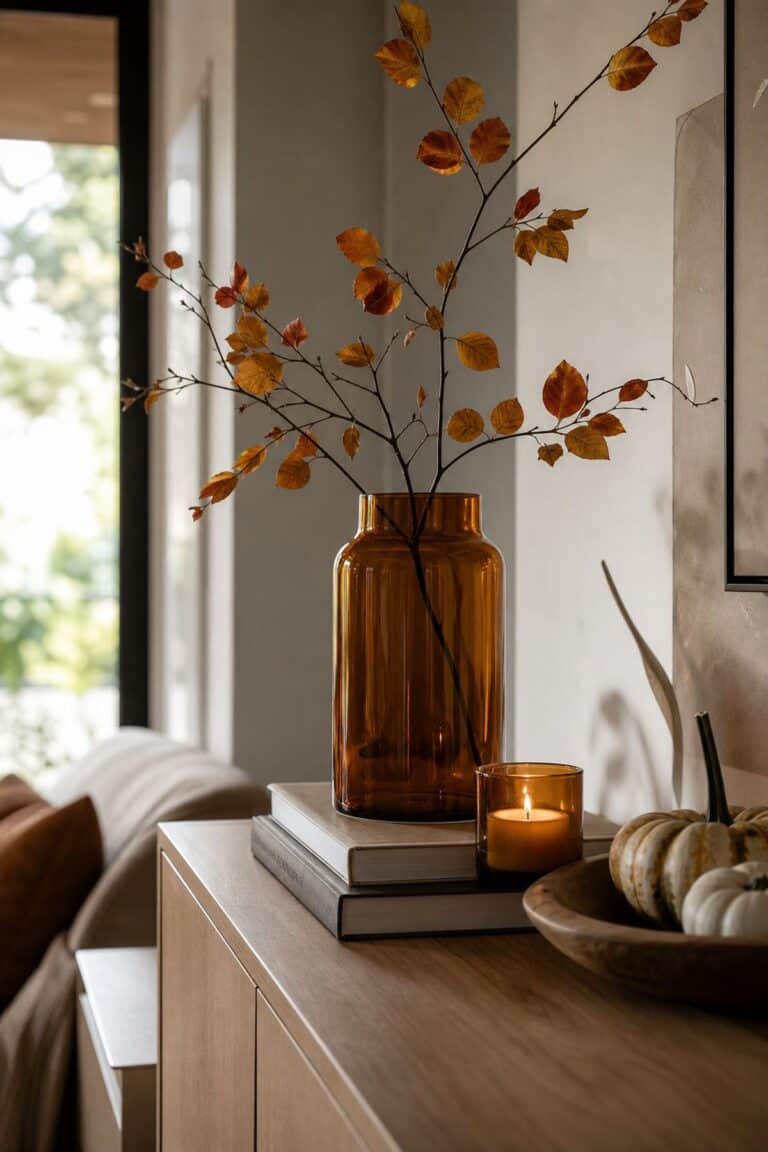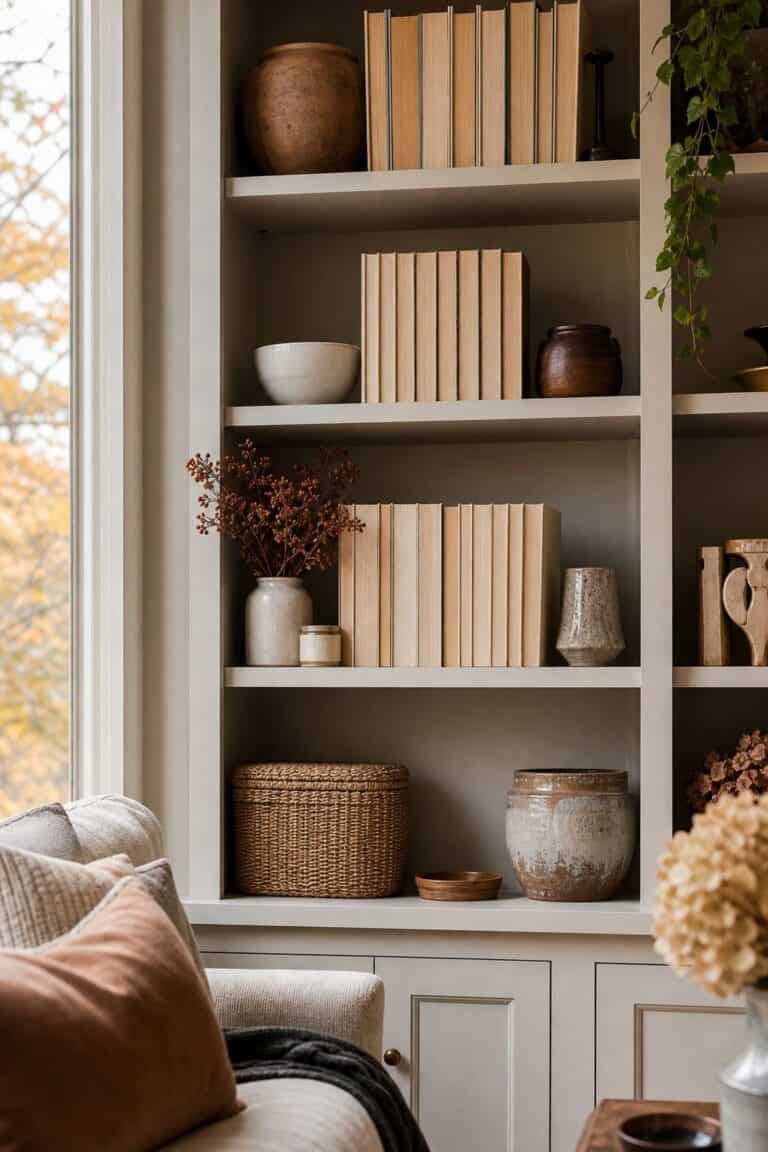

A fall mantel needs three things: something tall at one end, warm light across the middle and one low, heavy piece at the other end, with at least a third of the shelf left empty. Build that base in September, then swap only the small pieces for Halloween and Thanksgiving.
Small fact that changes how I look at autumn fireplace decor: the mantel is the one shelf in the house that everyone faces when they sit down, usually with a drink, usually for a long time, and usually after dark. So it gets stared at more than your coffee table ever will (sorry, coffee table). That also means every wobbly little gourd and every random candle gets noticed.
Most people style a mantel once, panic about Halloween, then rebuild it for Thanksgiving and get tired of the whole thing by November. These 18 ideas do it the lazy way instead: one base that stays from September to the end of November, a few small swaps for each holiday, a hearth that doesn’t get forgotten, and a quick night test so you know when to stop adding things.

Recommended blogs to read:
- fall home decor ideas
- fall front porch decor ideas
- fall table decor ideas
- fall apartment decor ideas
- fall wedding decor ideas worth copying, from arch
- summer coffee table decor ideas
- summer decor
- living room corner decor ideas
Before buying anything, clear the mantel completely and put back only the two biggest things you already own, a mirror or a piece of art and one tall vase. If your fireplace sits in the living room, my fall living room decor ideas help the rest of the room match what you build up there.
How Do You Build a Fall Mantel From Scratch?
Start with height on one side and the biggest flat piece (art or a mirror) behind everything, then add candles and one low cluster. Those four ideas below are the skeleton, and almost everything later in the list hangs off them.
1. Large Branches at One End
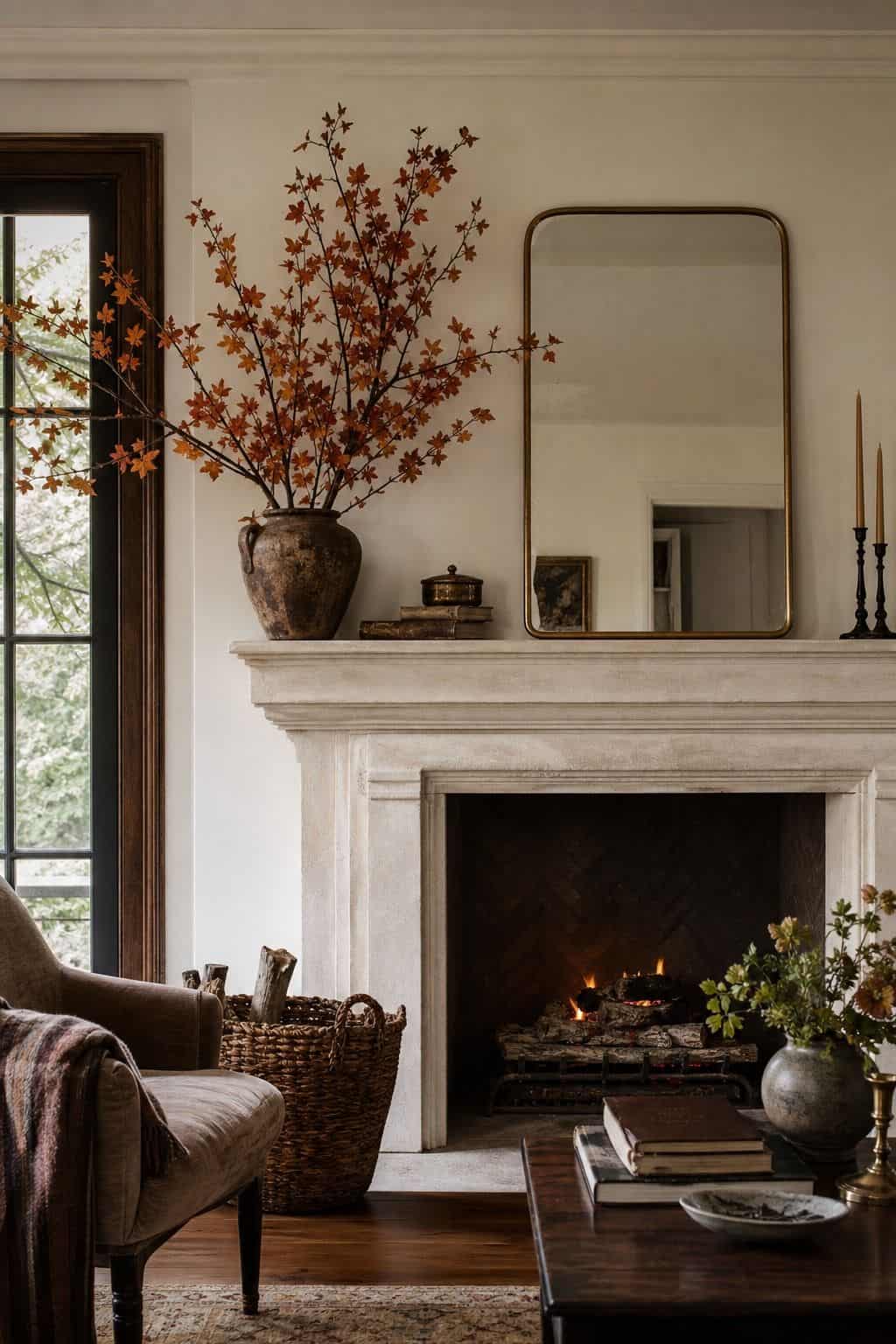


Tall branches at one end do the hardest job on a fall mantel, which is giving it a shape. Without something tall, a mantel is just a flat line of objects at the same height and it looks like a shelf in a gift shop. Here a dark vase sits right at the left edge with red-brown branches spreading up and slightly out over the wall, so the eye starts there and travels right toward the mirror.
Branches cut in the yard or picked out of the florist’s bucket are cheaper than faux ones and they look better, they just dry out by November (which is fine, dried leaves are still fall). Use a heavy vase with a wide base, or drop a handful of stones inside, because tall stems tip easily and the fire is right below.
2. Leaned Fall Art

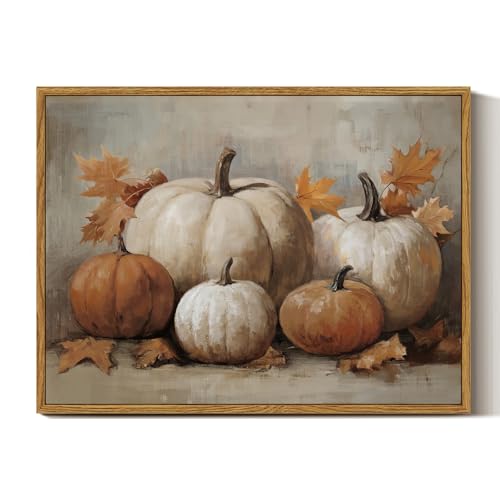

Why lean art instead of hanging it? Because then you can change it with the season without a drill, and a leaning frame looks relaxed in a way a perfectly centered hanging picture never does. A small autumn countryside painting in a gold frame, like this tree painting, is enough to say fall without a single pumpkin in sight.
Put the frame toward the back, a little off-center, and let other pieces overlap the bottom corner so it looks layered. A jug of orange leaves in front of one side and tapers on the other side is plenty. Thrift stores are full of old countryside paintings for very little money, and the slightly dark, slightly dirty ones look the most like fall. If you rent and can’t put a nail in the chimney breast, leaning is your best friend anyway.
3. Brass Taper Candle Pair
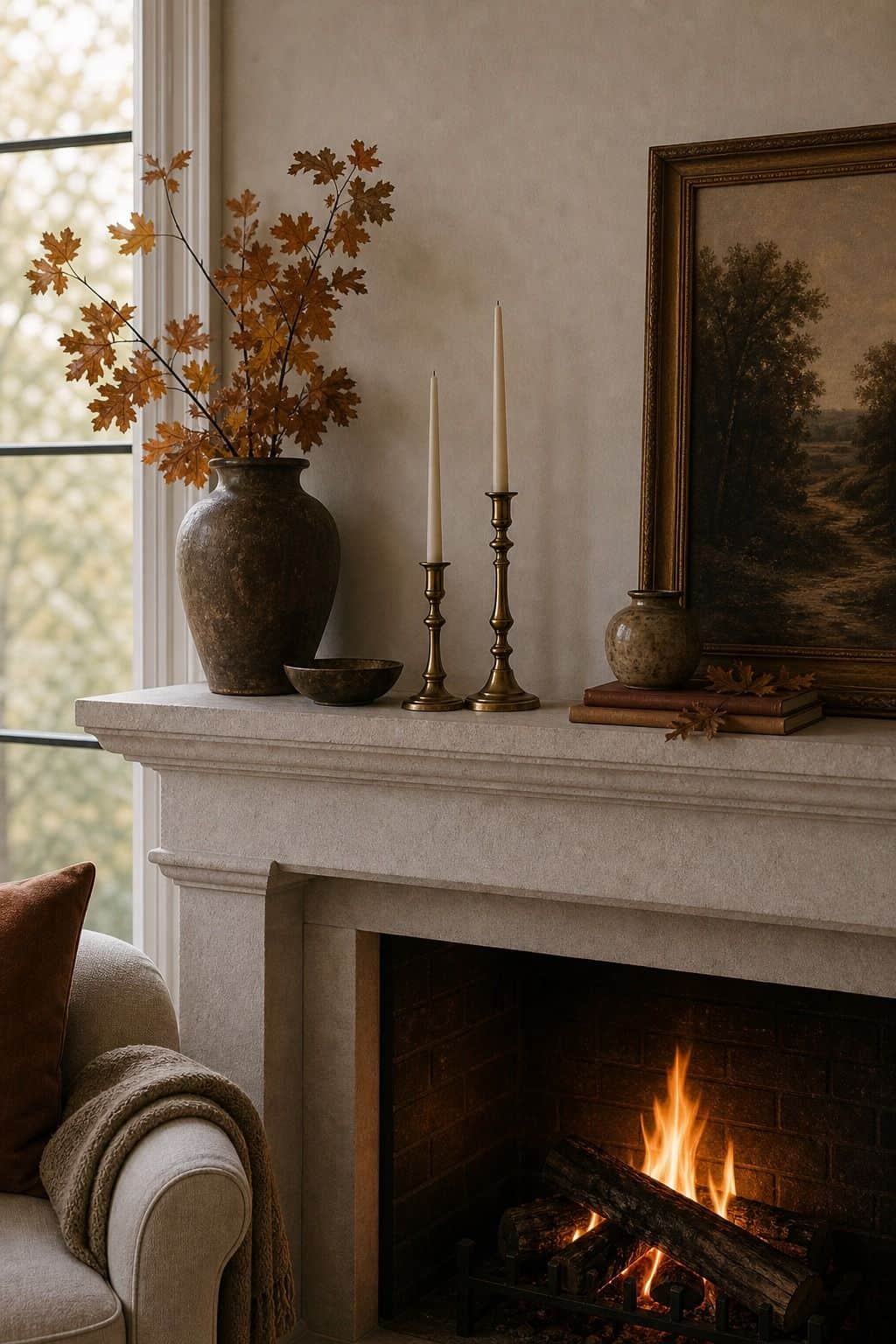


Buy two brass candlesticks before you buy any fall-specific decor, because they’re the most useful thing a mantel can own and they work in every season. In fall, with ivory tapers, they give the mantel height without bulk, and once the tapers are lit the brass picks up the firelight below.
Keep them as a pair, but don’t put one at each end like bookends. Grouped together slightly off to one side, next to the orange leaves, they look more natural. Different heights are fine too.
One honest note: real tapers drip, and a mantel above a burning fire gets warm, so tapers can lean or soften if they sit right above the opening. Set them toward the back of the shelf and away from anything dry, and if the fire is going all evening, swap in flameless tapers. Nobody can tell from the sofa.
4. Neutral Pumpkin Cluster
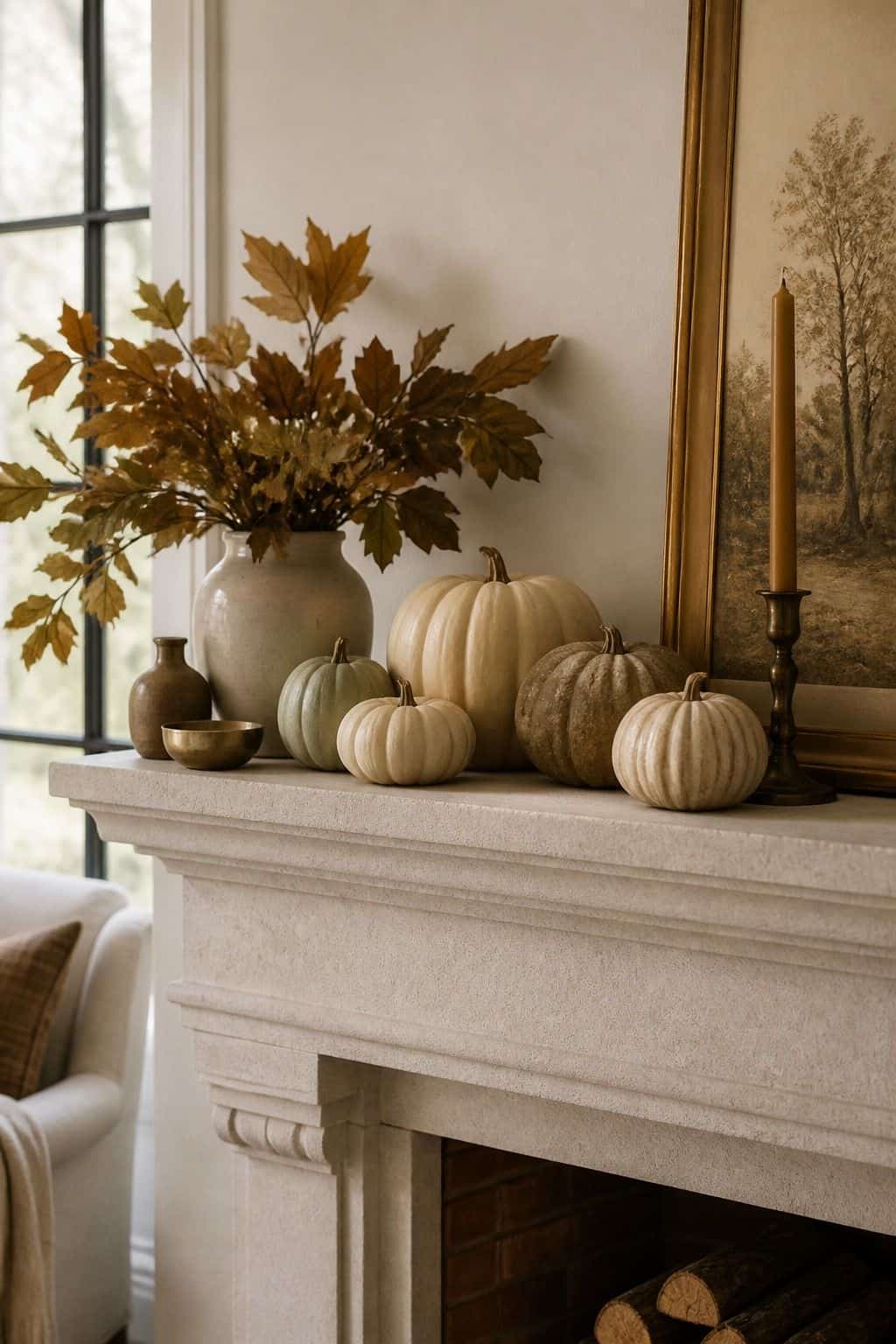


A pumpkin cluster belongs at the opposite end from your tall branches, because it’s low and heavy and it balances the mantel visually. Cream, white and pale green pumpkins are the easy choice here: they go with orange leaves, with a brown painting, with a gray stone surround, and they don’t fight your Christmas decor if you’re one of those people who starts early (no judgment).
Five or six in different sizes look better than one big and one small. Stack a couple so they touch, let one sit slightly forward, and keep the cluster tight instead of spreading pumpkins along the whole shelf. Real pumpkins last for weeks indoors if they’re not near direct heat. Faux ones are the safer pick right above a fire you use often, and they come back next year.
How Do You Make a Mantel Look Collected Instead of Bought?
Mix materials that look like they came from different places, like stoneware, glass, old books and real leaves, and let one side be heavier than the other. A row of matching store pieces lined up evenly is what makes a mantel look like a shop shelf.
5. Low Garland Across the Mantel
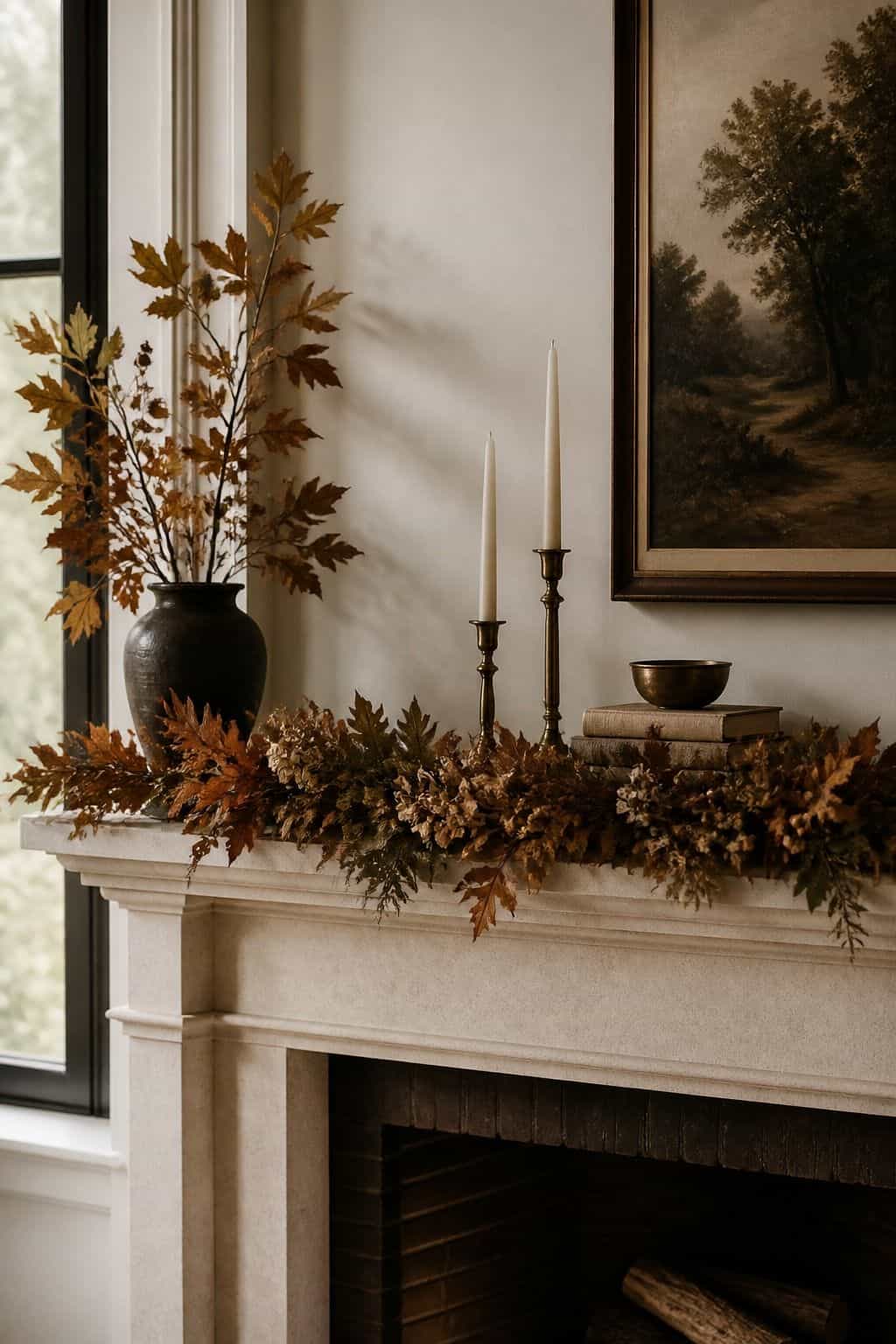


Lay a fall garland low and flat along the front edge of the shelf, like this dried leaf one, instead of draping big loops down over the fireplace opening. A garland ties the mantel together from one end to the other, so separate objects suddenly look like one arrangement, and kept low it does that without hiding anything.
- Lay it flat first, then pull a few leaves forward so it doesn’t look like a rope.
- Let one end trail a little past the corner, but keep the middle above the firebox short.
- Tuck the ends behind a vase or a pumpkin so you don’t see where it starts.
- Skip anything plastic and shiny; dried or good faux leaves in matte browns look far richer.
If you light the fire often, nothing should hang down in front of the opening. Garland stays on top of the shelf.
6. Amber Glass Votives
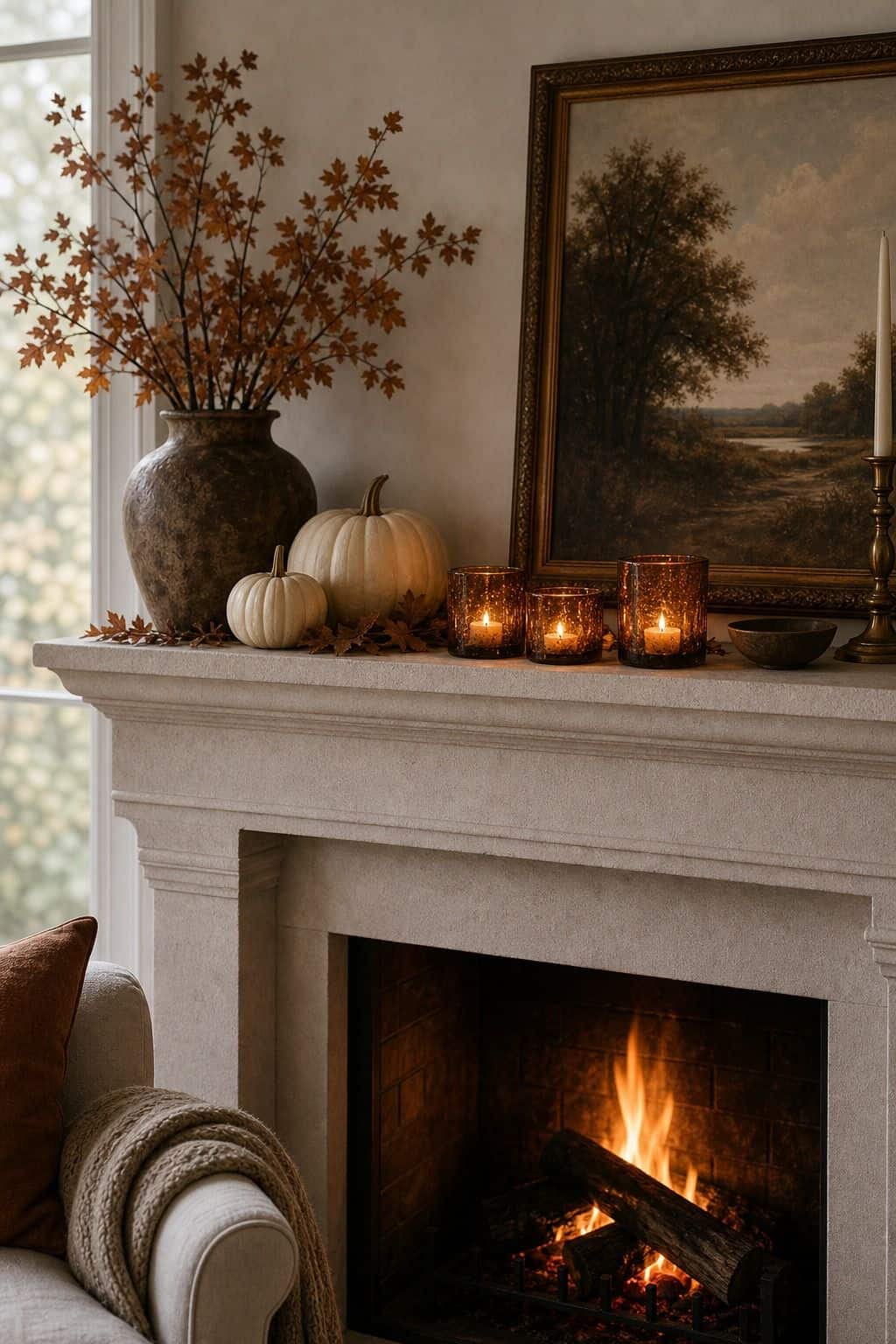


See the row of lit amber votives in front of the painting? That’s the cheapest way to make a mantel feel like fall at night. The glass turns ordinary white candle light into a deep orange glow, which matches the fire below, and a row of four or five lit votives in front of the painting looks warm even when everything else on the shelf is neutral.
Keep them in a short row or a small cluster between the tall and low groups, not scattered from one end to the other. Tea lights inside are fine (the amber hides that they’re tea lights), and LED ones look surprisingly real behind colored glass. My only rule: if the shelf is narrow, leave them out. Votives right at the edge of a shallow mantel get knocked off by the first person who leans on it.
7. Stoneware Vase Anchor


The big gray stoneware vase is the anchor here, the one piece that is clearly the boss of the mantel. Every good mantel needs one, because if every object is the same size, nothing looks important. Rough stoneware is a nice fall choice because the texture reads as earthy and handmade next to smooth candles and painted wood. Go bigger than you think. A vase that looks huge in the store usually looks right on a mantel, because you’re seeing it from across the room. Fill it with one kind of branch so it looks like one big shape, then let a couple of white pumpkins and the tapers sit at its feet. If you only splurge on one fall mantel piece this year, make it this kind of vase, since it holds tulip branches in spring and pine in December just as happily.
8. Books in Warm Covers
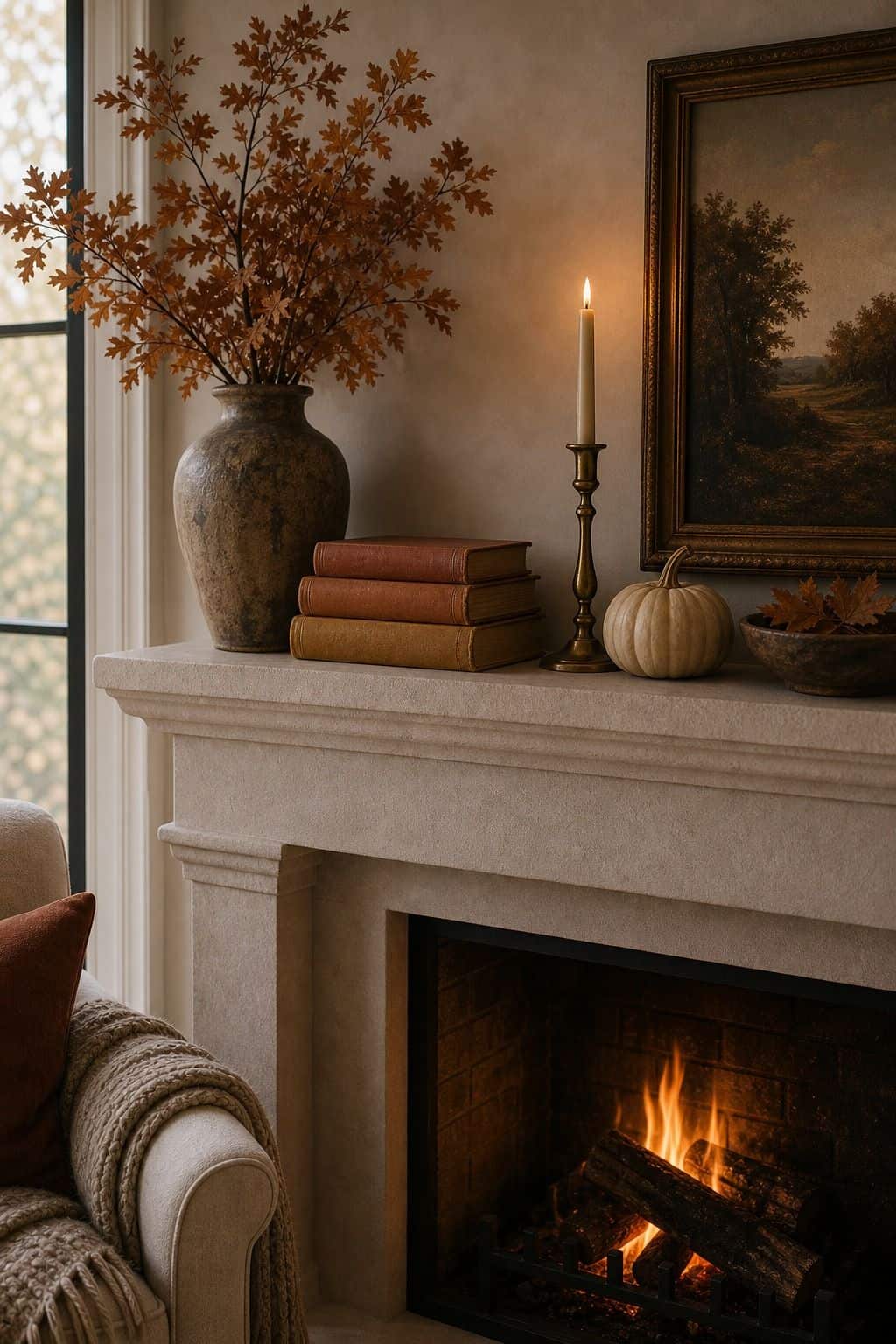


Raid your own bookshelf before you shop, because old books give a mantel a different height for free and the right covers do a lot of the color work for you. Look for rust, tan, brown and deep green spines and covers; take the paper jackets off if they’re bright, because the cloth underneath is usually much better looking.
Stack three or four flat, then put something small on top, like this white pumpkin, a little brass bowl or a candle. That one move makes a stack look styled instead of stored. Use the books to lift a small object that would get lost otherwise, which is their real job up there. Got no pretty old books? Thrift stores sell them by the bag, and nobody needs to know you never read them.
9. Asymmetrical Mantel Shape
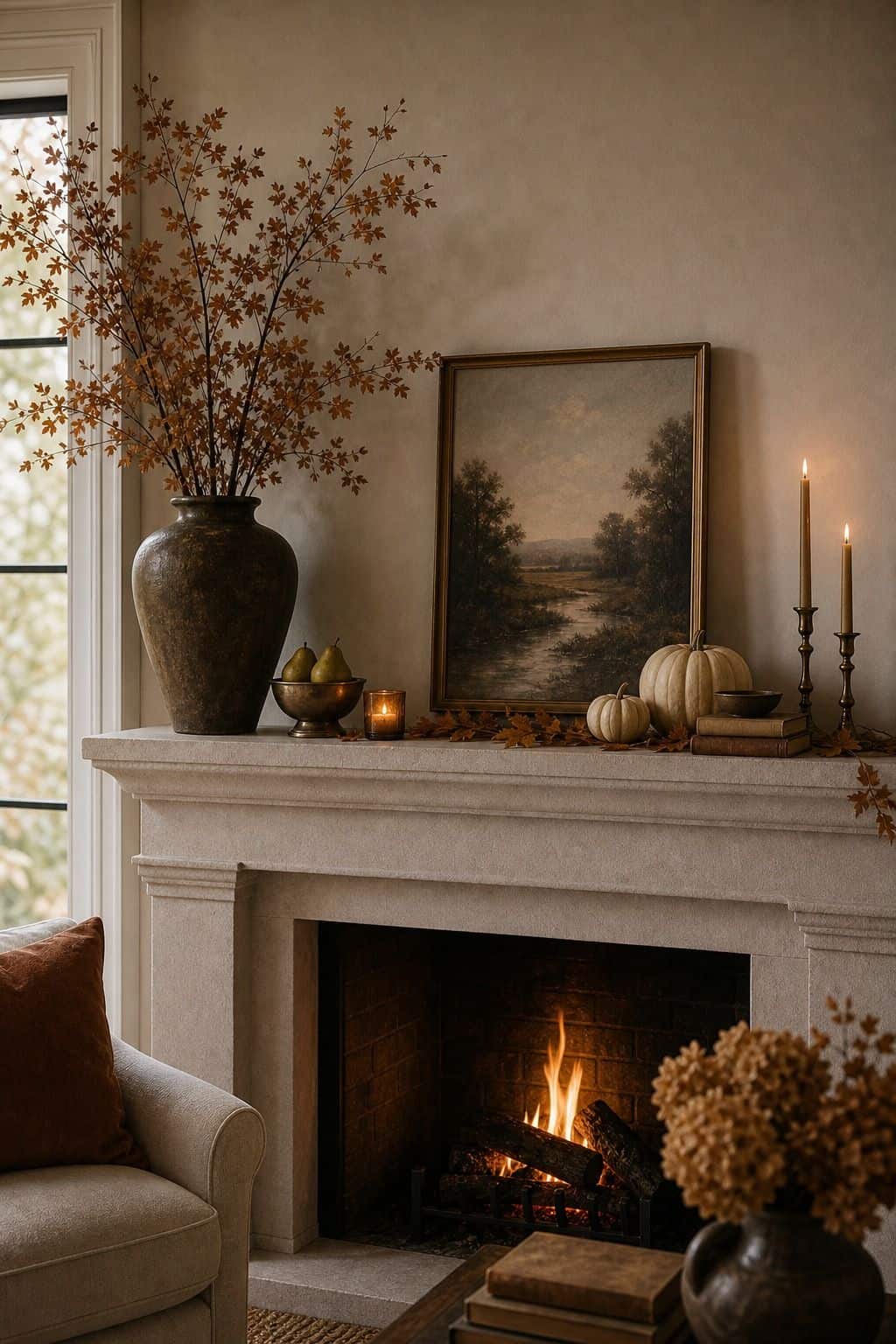


Asymmetry is what makes a fall mantel look relaxed instead of stiff. A perfectly mirrored mantel (one vase each side, one candle each side, painting dead center) can look formal and a little cold, while uneven groups feel like a home.
The easiest version is to think of a lopsided triangle: tallest at one end, the art a bit off-center, then things get lower toward the other end. That’s exactly what’s going on here with the branches high on the left and the candles stepping down on the right. The weight has to balance, though, so if one side is tall and light, the other side needs something low and heavy.
One clue that you got it right: you can’t draw a line down the middle and fold it like paper. If you can, move one thing.
What Goes Above and Below the Mantel Shelf?
A mirror or art above, and almost nothing below. The wall gives the mantel a backdrop and the hearth just needs one or two practical pieces.
10. Mirror Catching Firelight
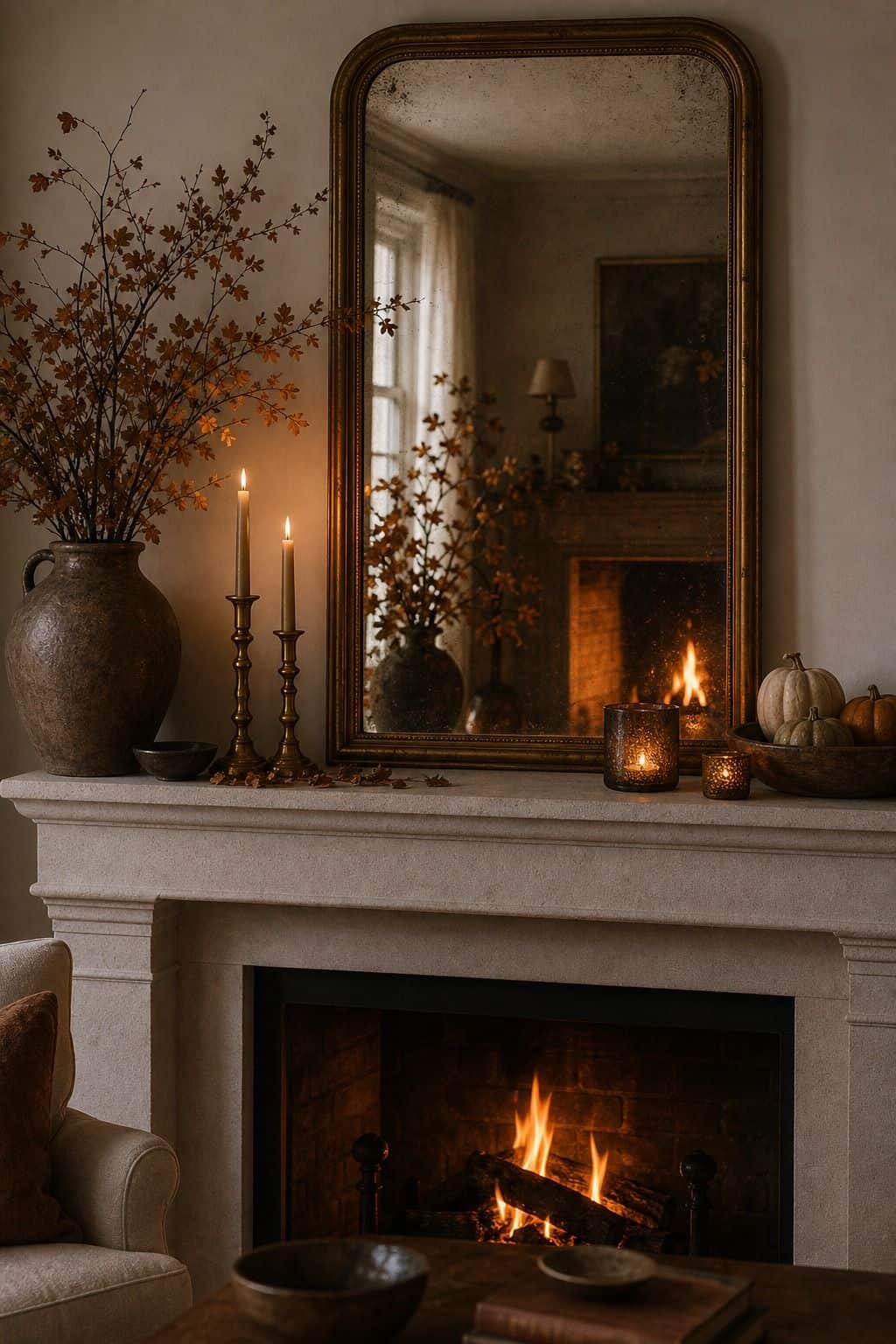


Why does a mirror work so well over a fire in fall? It doubles every light source. The tall arched mirror here catches the tapers, the votives and the glow from the fire, so the whole wall looks lit from the inside once the evening starts, which is exactly when you want it.
A mirror also makes a small living room feel bigger, which matters when the sofa is pushed close to the fireplace for the season. Lean it if it’s light enough, hang it if it’s heavy, and keep the decor in front of it low so you still see the reflection. Here’s my one warning: check what it reflects from the sofa. If it shows your messy hallway or the TV, move it or angle it a little, because you’ll be looking at it all winter.
11. Hearth Kept Simple
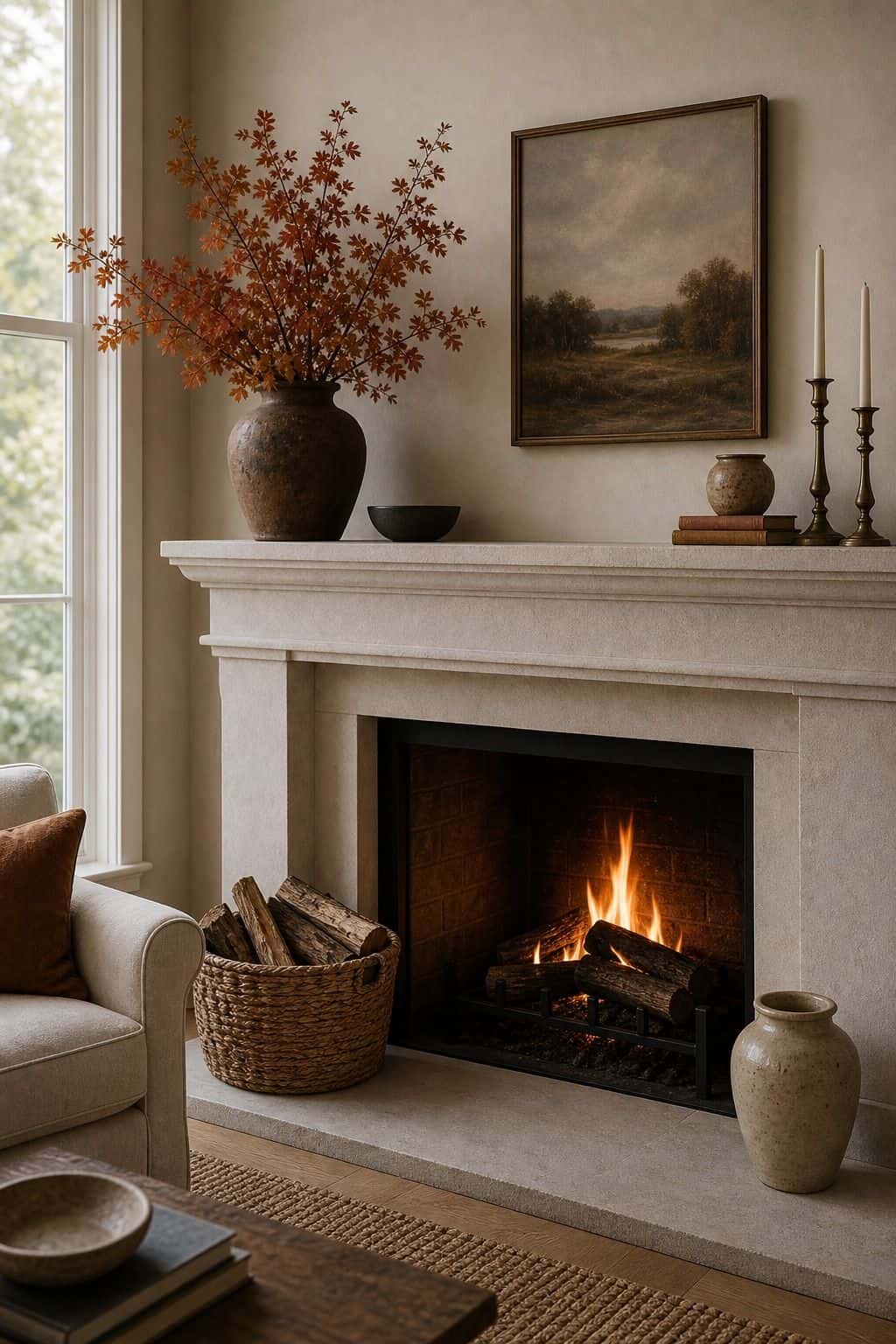


The hearth is the part of autumn fireplace decor people forget, and then it looks empty or turns into a pile. Keep it simple: one basket of logs on one side and one jug or vase on the other, like this wicker basket and cream jug. That’s it.
If you burn wood, the basket is useful and good looking at the same time, which is my favorite kind of decor. If your fireplace is decorative or gas, the basket can hold a throw blanket instead. Anything on the hearth should be something you don’t mind stepping around, because people stand there to warm their hands, and pets love it.
Keep paper, dried flowers and fabric well away from the opening on a hearth you actually use, and a sturdy screen beats any decoration. For the full fireplace look in November, my Thanksgiving fireplace decor post covers the sides and hearth for a crowd.
How Do You Switch a Fall Mantel From Halloween to Thanksgiving?
Keep the base and trade one small group of objects: dark pieces in October, harvest pieces in November. It takes about ten minutes when the big items stay put, and you never have a bare mantel in between.
12. Halloween Detail Removed Later
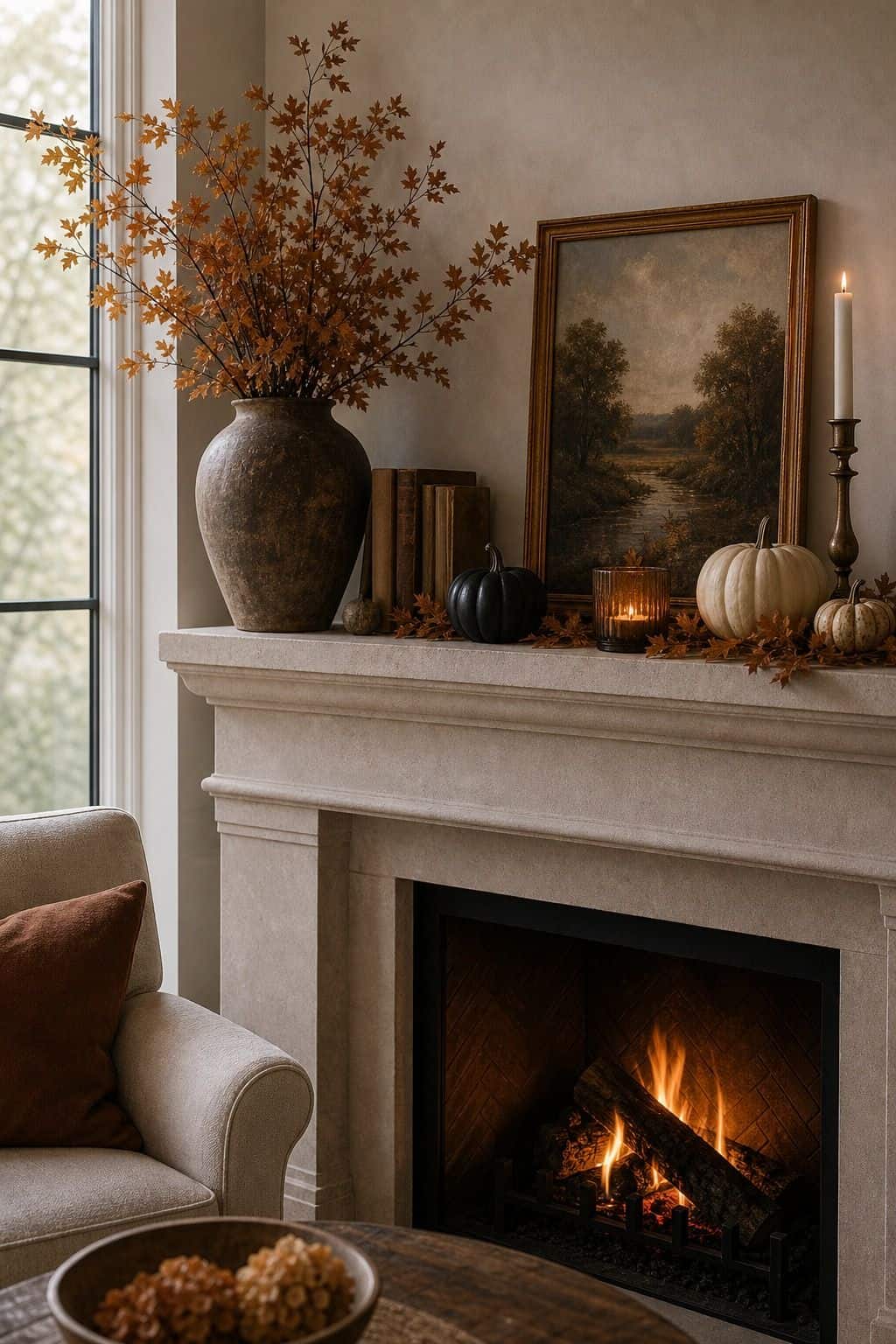


In this photo, one small black pumpkin tucked between white ones is the whole Halloween update. That’s the easiest Halloween mantel you’ll ever do: add one dark thing to your fall base and stop, because it’s enough to make the whole mantel feel like October without a skeleton or a witch in sight.
Black pumpkins, a black taper or two, a dark velvet ribbon around the vase, maybe a little brass bell. Pick one or two. On November 1st they go back in a box and the mantel is fall again, no rebuild needed.
This is the part that saves you, because the big things never move. You’re only ever swapping two or three small objects.
13. Thanksgiving Layer Added Later



Swap the dark pieces for a harvest layer in November, on the same base: a bundle of wheat, a bowl of pears and a few dried hydrangeas, like the ones added in front of this mirror. Those things say food and harvest, and they look right on the day you’re feeding people.
Pears are my secret here. They’re cheap, they come in lovely brown and green colors, they last about a week on a cool mantel and then you eat them. Hydrangeas dry beautifully if you leave them in a vase without water, so a couple of stems from late summer can carry you to the end of November. The wheat bundle can stay until December, then it goes and the greenery comes in. If you’re setting a table for the day too, my fall table decor ideas bring those pears and stems down to the table.
How Do You Know When Your Fall Mantel Is Finished?
It’s finished when the colors repeat, one object has a story, it looks good with the lights off and you can still see bare stone or wood between the groups. The last five ideas are really checks more than decorations.
14. Cream and Rust Palette


How many colors are on your mantel right now? Two is the number that makes a mantel look calm, and cream with rust is the friendliest fall pair there is. The cream covers the stone, the pumpkins and the candles; the rust comes from the terracotta vase, the leaves and one rust pumpkin. Everything else is wood, brass or the painting.
Look at your mantel from the sofa and count colors. More than three, and it starts to look busy fast. A mantel with orange, purple, red, yellow and green (yes, people really do this) reads as a craft store bin, while one color plus a neutral reads as a plan. If your stone is gray instead of cream, swap the cream for white and keep the rust, it still works, I promise.
15. Wood Bead Texture


Wood beads add texture that isn’t leaves, and they cost very little. The beads catch the light differently from everything else on the mantel, and the round shapes soften all the straight lines of the shelf, the frame and the candles.
Drape it in one loose swoop and let one end with the tassel hang over the side, the way this one does, instead of laying it in a neat line. It looks more casual that way. Real fall bonus: wood beads don’t shed, unlike dried leaf garland that leaves crumbs on the floor every time somebody walks past.
Watch the length, though. Near a working fireplace, keep the hanging end at the outer corner of the mantel, never in front of the opening, and short enough that nobody catches it. And if you already have a leaf garland, pick one or the other; two garlands on one mantel is one too many.
16. One Heirloom Object


Do you have one object with a story? Every mantel needs one, and fall is the season for it because the colors already look a bit old. This brass box with a handle is the perfect example: nobody would call it fall decor, but next to oak leaves and an iron candlestick it looks like it’s been in the family forever.
It can be anything: a grandmother’s brass box, a wooden bowl from a market trip, an old clock, a cast iron pan stand, a jar from your first apartment. Give it space so it doesn’t get lost among pumpkins. The point is that a guest asks about it, and suddenly you’re telling a story instead of talking about where you bought the pumpkins.
17. Nighttime Glow Test
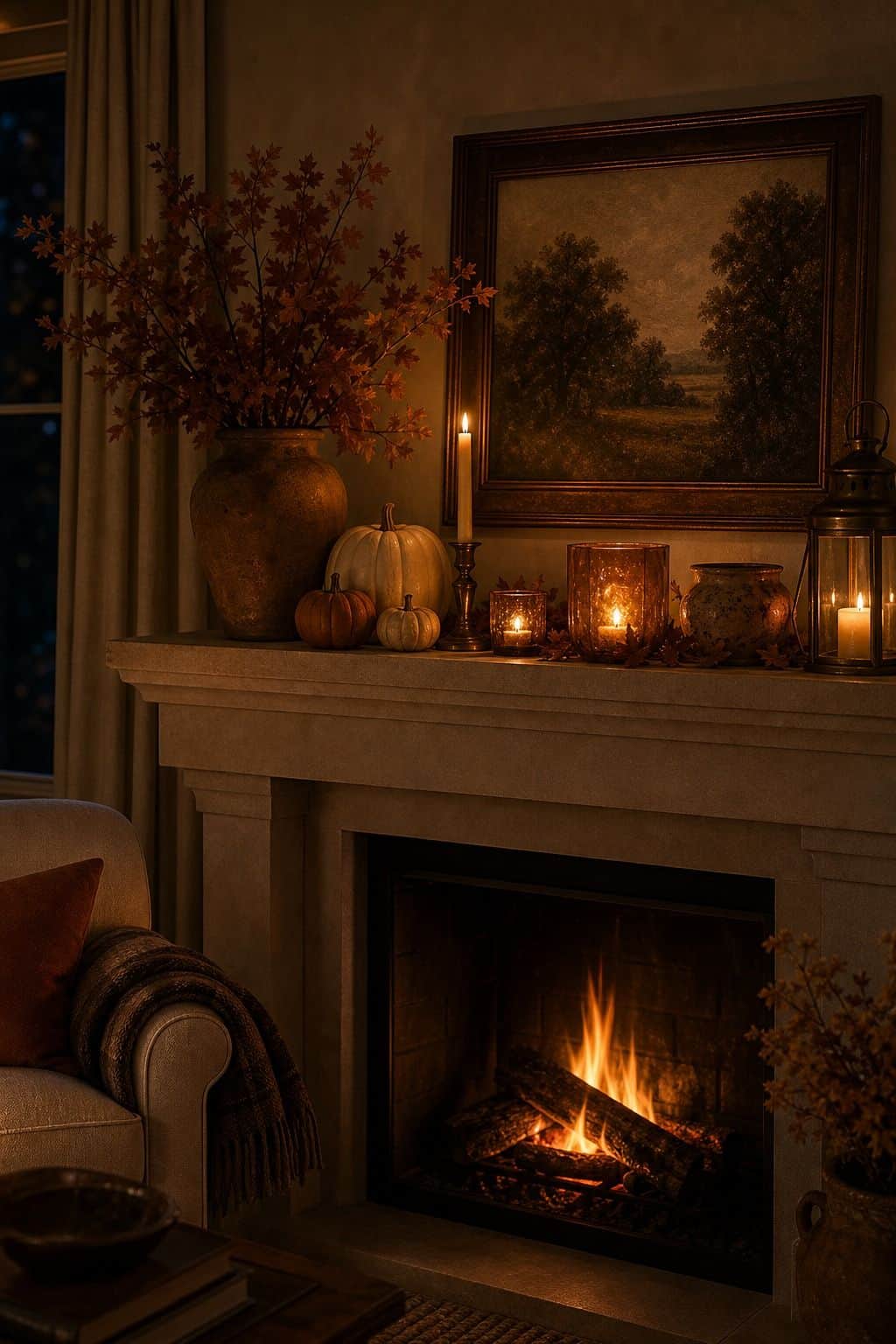


Turn off the big lights before you call the mantel done. Light the candles and the fire (or switch on your LED ones) and sit where you usually sit. Fall evenings are long and dark (here in Finland it’s dark before five by late October), so this is the view you’ll have most of the season.
In the dark you’ll notice things you missed in daylight. Pieces with no glow disappear, shiny plastic looks cheap, and gaps between the lights look like holes. Fix it by moving light, not adding stuff: shift a votive into the gap, put a lantern on the darker side, and check that the mirror or the brass catches something. Most fixes at this stage are just moving candles around, so don’t run to the store yet.
18. Mantel With Air Around It


Leaving empty space is the last idea and the hardest one, because it means taking things away. This mantel has one small vase with sparse branches, one little painting and one candlestick, and most of the white shelf is bare. It still looks like fall.
Here’s how I edit: take off one object, step back, and see if you miss it. If not, it stays off. Repeat until you miss something, then put that one thing back.
And if your style leans quiet and expensive-looking overall, my elegant fall decor ideas use the same idea in every room.
What Colors Look Best on an Autumn Fireplace?
Rust, cream, brown, olive and brass look best on most fireplaces, because they echo firelight and wood instead of fighting them. Pick one main fall color and one neutral that matches your surround, then let brass or wood fill in.
White and cream stone loves rust and terracotta. Red brick looks better with cream, olive and brass than with more orange (orange on red brick gets loud fast). Dark painted fireplaces look great with white pumpkins and amber glass. And if you want something less expected, deep burgundy with brass is gorgeous at night.
Can You Decorate a Mantel Above a Fireplace You Actually Use?
Yes, as long as nothing that can burn hangs down in front of the opening and the most heat-sensitive pieces sit toward the back or the ends. Mantels above a real fire get warm, so candles soften, dried stems get brittle and faux pieces can warp right above the opening.
Keep dry branches, paper and fabric away from the opening, use a fireplace screen, and use flameless candles on nights the fire burns for hours. Your local fire safety rules and your fireplace’s manual are the final word, so check those if you’re unsure.
Frequently Asked Questions
How do you decorate a fireplace for autumn?
Start with one tall piece at one end of the mantel, a mirror or art behind, candles across the middle and a low pumpkin cluster at the other end. Add a basket or jug on the hearth and leave some of the shelf empty so it doesn’t look crowded.
What can I put on my mantel for fall instead of pumpkins?
Branches in a big vase, old books in warm covers, brass candlesticks, amber votives, pears, wheat and an old wooden or brass object all say fall without a single pumpkin. Dried hydrangeas and wood bead garland work too.
When should fall mantel decor go up and come down?
Most people put up the fall base in early to mid September and keep it until the end of November. Add a dark Halloween piece in October, switch it for a harvest layer in November, then swap to winter greenery after Thanksgiving.
How many items should go on a mantel?
Usually five to seven pieces or groups, counting the art, the tall vase, candles and one low cluster. If you can’t see bare shelf between the groups, take one thing away.
Key Takeaways
- Tall at one end, low and heavy at the other, art or a mirror in between.
- Leave about a third of the mantel bare so each group can be seen.
- Halloween and Thanksgiving are small swaps on one September base.
- Two colors plus brass or wood keeps an autumn fireplace calm.
- Judge the mantel at night with candles lit, then edit by moving light.
Set the Base in September, Swap the Small Stuff Later
If it’s still early fall where you are, this is the perfect weekend to build the base: vase, art, candles, one low cluster, done. Then put a small box next to it with your black pumpkin for October and your wheat and pears plan for November, and you’ll never stare at a bare or overstuffed mantel again this year. Light it tonight, sit down, and see how it looks from the sofa.