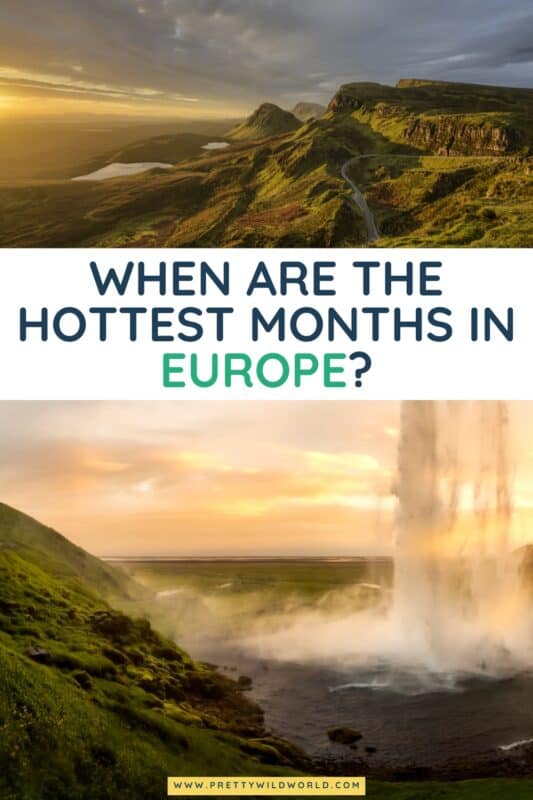
The hottest months in Europe are July and August — mid-July to mid-August traditionally hits peak — with Athens 33°C, Madrid 32°C, Rome 31°C and Lisbon 28°C in average summer highs. The pattern is shifting: 2025 was the hottest European summer on record and late-May 2026 brought a record heat dome. The Copernicus 2026 summer outlook is above-normal across all regions.
Europe’s traditional hottest stretch is mid-July to mid-August. In 2025 that window pushed back into May. Late-May 2026 hit 10-15°C above the 1991-2020 baseline across Western Europe — what climate scientists are calling the new pattern. Spain touched 46°C in June 2025 (a national record set in spring, not summer). Europe is heating roughly twice as fast as the global average.
The hottest months in Europe data answer is two-sided. The historical answer remains July and August — the absolute hottest day of any year falls in this window in 90%+ of years. The shifting-pattern answer is that severe heat now arrives earlier (May and June heat domes), persists longer (Mediterranean September often peaks late-summer levels), and brings dangerous extremes (~16,500 heat-attributable deaths estimated for summer 2025 across Europe).
The traveller’s practical implication: plan around the data rather than the assumption. The Aug 12, 2026 total solar eclipse in Iceland is the year’s best cool-Europe escape. Northern destinations (Lofoten, Cornwall, Bohinj) work even at peak heat. Inland cities (Madrid, Athens, Rome, Seville) become brutal in July-August and reward different timing.
Budgeting the cool-Europe escape instead of the brutal-heat trip?
The Ultimate Budget Planner walks through monthly savings targets and real cost categories for the Lofoten, Cornwall or Iceland alternative — premium August accommodation, flights, hire car.
Recommended Hot-Weather Europe Travel Gear




Recommended blogs to read
- Summer in Europe
- Europe in August
- Best Time to Visit Europe
- When Is the Coldest Month in Europe
- Packing List for Europe Travel
What Is the Hottest Month in Europe?
July, by a narrow margin over August, across most of Europe. The historical data shows July averaging fractionally hotter than August in major Mediterranean and Western European cities, with August occasionally setting the year’s single hottest day in heatwave years.
City-level data (1991-2020 averages): Athens July 33°C / August 33°C (essentially tied). Madrid July 33°C / August 32°C. Rome July 31°C / August 31°C. Seville July 36°C / August 35°C. Lisbon July 28°C / August 29°C (August fractionally hotter). Barcelona July 28°C / August 29°C. Paris July 25°C / August 25°C.
The shifting pattern in 2025-2026: severe heat extends earlier into the year (Spain June 2025 record 46°C; late-May 2026 heat dome 10-15°C above baseline) and later (Greek islands holding 30°C through mid-September). The traditional July-August peak still holds for the absolute single-day record in most years, but the heat season effectively runs late May through late September across the Mediterranean now.
Which European Cities Are Hottest in Summer?
Seville, Spain
Seville is consistently the hottest major European city — July average high 36°C, August 35°C. The 1991-2020 baseline. Summer 2025 saw daily records broken across June-August. Sevillanos leave the city for August; the city operates on heat-survival mode from late June onward. Single-day records in the region have hit 47°C (Cordoba 2017).
Athens, Greece
Athens July average 33°C; August 33°C. The Acropolis often closes access in heat warnings above 38°C. Recent summer closures became routine; summer 2026 forecast continues the pattern. The meltemi wind (north-westerly) provides relief on the islands but not in Athens itself.
Madrid, Spain
Madrid July 33°C; August 32°C. The Spanish capital has no sea breeze (Madrid sits in the central plateau at 650m elevation). Daily highs often exceed 38°C in heatwave conditions. The Madrid Metro is air-conditioned (relief during peak heat). The Prado, Reina Sofía and Thyssen museums all air-conditioned (the day’s heat-escape strategy).
Rome, Italy
Rome July 31°C; August 31°C. Many older buildings without air conditioning. The Vatican Museums queue in August is brutal. Rome typically empties of locals around Ferragosto August 15.
Lisbon, Portugal
Lisbon July 28°C; August 29°C. The Atlantic breeze keeps Lisbon notably cooler than Madrid or Seville. The combination of summer warmth + Atlantic breeze + the city’s elevation (over the Tagus) makes Lisbon one of the most workable Iberian summer cities.
Paris, Berlin, London
Paris July 25°C; August 25°C. London 23°C / 23°C. Berlin 24°C / 24°C. Historically these were “warm but not brutal” summers. The pattern is shifting — London summer 2025 mean 16.10°C (warmest ever recorded). Paris heat domes in summer 2025 pushed temperatures over 40°C for the first time in city history.
How Has Heat Changed in the Past 5 Years?
European heat has changed dramatically and measurably since 2020. Five data points define the shift:
2022: European summer hottest on record at the time. UK first time crossed 40°C (Coningsby, July 19, 2022). France set its national June high record.
2023: Second-hottest European summer on record at the time. Greece wildfires forced largest evacuation in Greek history (Rhodes, July 2023).
2024: Third-hottest European summer. Acropolis closures became standard heat-warning protocol.
2025: Hottest European summer on record. Spain June national record 46°C; UK summer mean 16.10°C (warmest ever); ~16,500 heat-attributable deaths estimated.
2026: Late-May heat dome 10-15°C above 1991-2020 baseline across Western Europe. Copernicus summer outlook above-normal across all regions with major drought signal across Iberia, France, Italy, the Balkans and Central Europe.
Europe is heating roughly twice as fast as the global average, per the European Environment Agency’s analysis. The traveller-meaningful implication: the heat patterns of the 2000s and 2010s no longer apply. Mid-July to mid-August in inland Mediterranean Europe is regularly 35°C+; in heatwave conditions, 40°C+.
What Is the Summer Outlook for Europe?
The Copernicus Climate Change Service published the 2026 summer outlook in early April 2026. The signal: above-normal temperatures across every European region, with a significantly elevated probability of major heatwaves.
Regional outlook specifics: Iberia, France, Italy, the Balkans and Central Europe — major drought signal continuing from 2025. Northern Europe (UK, Ireland, Scandinavia) — above-normal but less extreme than the southern signal. Northeast Europe (Poland, Baltics) — wet rather than dry but still warm.
The late-May 2026 heat dome was the first major manifestation. Western Europe (Paris, Madrid, London, Berlin) hit 10-15°C above the 1991-2020 baseline. Some inland Iberian sites touched 41°C in late May — a temperature historically associated with mid-July.
The traveller’s practical takeaway: assume future summers will deliver at least 2025-level heat across the Mediterranean. Plan around it. Book the cool-Europe alternatives early. Reserve museum tickets (the daytime air-conditioned heat-escape) for the peak afternoon hours. Pack lightweight UPF clothing rather than the typical summer cotton.
Where Should You Go to Escape European Heat?
Lofoten Islands, Norway
Daytime August average 14-16°C. Twenty hours of daylight in early August. Reine and Henningsvær as the iconic fishing-village photographs. Hiking conditions at the year’s best.
Cornwall, England
August average 19-21°C — actual summer weather without the heat dome. St Ives, Padstow, Mousehole as the bases. Surf at Watergate Bay; walks at Land’s End.
Lake Bohinj, Slovenia
The quieter alternative to Lake Bled, 30 minutes deeper into the Julian Alps. August water temperature 22°C — swimmable. Average August 21°C in Bohinj village.
Iceland — and the August 12 Eclipse
August average 12-15°C across Iceland. The August 12 total solar eclipse crosses the Westfjords, Snæfellsnes, Reykjavík and Reykjanes — first Iceland totality since 1954, next 2196. Pricing 180%+ above normal for eclipse week (August 9-13); outside that week, Iceland in August is one of its best months.
Azores
Atlantic islands halfway between Lisbon and Boston. August 23-25°C — warm enough for swimming, not hot. The Azores High pressure system keeps these islands sunny when mainland Iberia faces drought.
Zermatt, Switzerland
Village at 1,620m, average August 18°C. Klein Matterhorn cable car climbs to 3,883m — 15-degree temperature drop. Glacier Paradise stays under 5°C even in August.
How Do You Travel Safely in European Heatwaves?
Heatwave-aware travel reduces the trip’s risk substantially. The standard protocol:
Schedule sightseeing for 6 AM-11 AM and 6 PM-midnight. Sleep through 11 AM-6 PM (the Spanish siesta pattern is functional in heat).
Pre-book air-conditioned museum visits for the peak afternoon heat. The Prado in Madrid, Vatican in Rome, Louvre in Paris all run AC strong enough to be the day’s heat-escape.
Pack UPF-rated clothing rather than standard cotton. UPF 50+ shirts (Columbia, Decathlon, Patagonia brands) block 98% of UV. Standard cotton blocks roughly 50%.
Carry electrolyte mix sachets. Plain water at very high heat actually flushes electrolytes faster than it replaces them. The Liquid IV, SOS Hydration and SaltStick brands all sell travel-portable single-serve sachets.
Know the local heatstroke signs: confusion, lack of sweating despite obvious heat exposure, body temperature above 40°C. Both are medical emergencies — call 112 anywhere in the EU.
Use public fountains. Most European cities maintain public drinking fountains (Rome has 2,500 nasoni fountains; Paris over 1,200 Wallace fountains; Barcelona over 1,000 font kanella). The free-water network reduces both cost and dehydration risk.
Want the cool-Europe escape plan (Lofoten, Cornwall, Bohinj)?
The Europe Trip Planner has the seven-day cool-alternative itineraries for each — flights, accommodation, hiking trail picks, day-by-day weather assumptions.
What Months Are Best If You Want to Avoid Peak Heat?
For Mediterranean Europe avoiding peak heat: late April through early June (spring shoulder), or mid-September through October (autumn shoulder). Both windows offer mid-20s daytime temperatures, warm-but-not-hot sea, fewer crowds.
For Northern Europe (cool climate even at peak): July and August work. Daylight at peak. The traditional summer experience.
For Alpine and mountain Europe: any of June-September. Higher elevations stay cool regardless of valley heat. August Alpine hiking is at its safest weather window before autumn snow arrives.
For Scandinavia: June and July for maximum daylight. August begins to cool noticeably.
Frequently Asked Questions
What is the hottest month in Europe?
July, by a narrow margin over August, across most of Europe. The single hottest day of any year usually falls July 15-August 15. Heat patterns are shifting earlier — June 2025 saw Spain’s national record 46°C, and late-May 2026 brought a record heat dome.
Is July or August hotter in Europe?
Statistically about equal. Athens, Madrid, Rome and Paris all average within 1°C of each other for July vs August. Lisbon and Barcelona run fractionally hotter in August due to the Atlantic and Mediterranean sea temperature lag. The single-day record more often falls in August.
Where is the hottest place in Europe in summer?
Seville (Spain) — July average 36°C; August 35°C. Single-day European records have hit 47°C in Andalusian inland regions. The Greek islands (especially the eastern islands) and Sicily reach similar averages. The European all-time temperature record is 48.8°C in Sicily, August 2021.
Is Europe getting hotter?
Yes — roughly twice as fast as the global average per the European Environment Agency. 2022, 2023, 2024, 2025 each broke previous summer-temperature records. Late-May 2026 set a new May heat-dome record. The 2026 summer outlook from Copernicus is above-normal across all regions.
When was the European heatwave?
Late-May 2026 brought a record heat dome to Western Europe — temperatures 10-15°C above the 1991-2020 baseline. Some inland Iberian sites hit 41°C in late May. The current summer forecast extends the pattern. Updates available through the Copernicus Climate Change Service.
Where in Europe is cool in summer?
Lofoten Islands (Norway) 14-16°C August; Cornwall (England) 19-21°C; Zermatt (Switzerland) 18°C; Azores (Portugal) 23-25°C; Iceland 12-15°C; Lake Bohinj (Slovenia) 21°C; Greek Cyclades with the meltemi wind. The Aug 12 Iceland eclipse is the year’s best heat-escape pairing.
Key Takeaways
- Hottest months: mid-July to mid-August traditionally. Peak city averages Athens 33°C, Madrid 32°C, Rome 31°C, Seville 36°C.
- Pattern shifting: 2025 hottest European summer ever (~16,500 heat-attributable deaths); late-May 2026 record heat dome (10-15°C above baseline).
- Europe heating ~twice as fast as global average per EEA analysis.
- Cool escapes: Lofoten 14-16°C, Cornwall 19-21°C, Zermatt 18°C, Azores 23-25°C, Iceland 12-15°C. Aug 12, 2026 Iceland eclipse the year’s best heat-escape pairing.
Final Thoughts
Europe’s hottest months are no longer just July-August. The pattern is shifting earlier and harder. Pack the UPF, plan the morning sightseeing, accept the siesta. The August 12 eclipse in Iceland is the year’s best cool escape; otherwise the spring and autumn shoulder seasons reward the traveller who wants Mediterranean Europe without the 38°C.