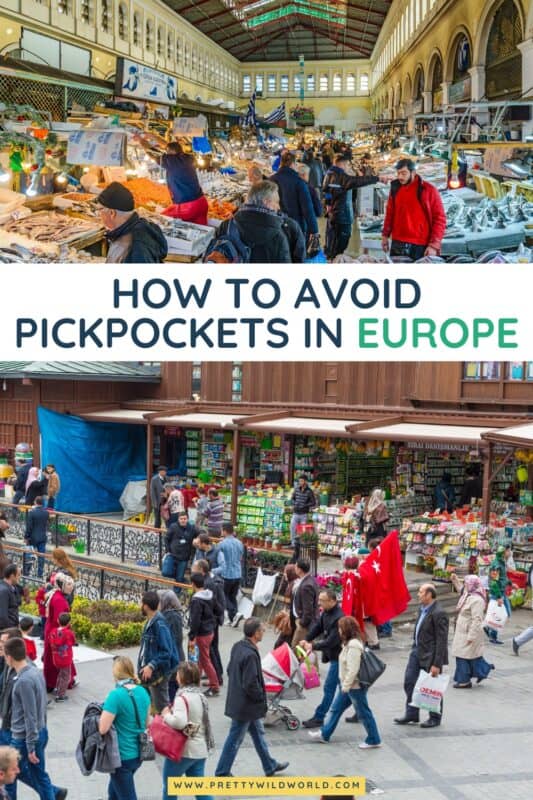
Barcelona has world-class hospitals, an excellent public-transit system, and one of the lowest violent-crime rates of any major European city. It is also the pickpocketing capital of the continent. The 2025 rate ran 2.9 times Spain’s national average. Pickpocketing accounted for roughly 48% of all crime reported inside city limits, with more than 100,000 incidents logged in a single year and 266 repeat offenders responsible for 1,776 arrests.
That gap, between a safe city and a stolen wallet, is almost entirely about preparation. The thieves working Las Ramblas, Métro 1, the 64 bus to St. Peter’s, and Athens Monastiraki are professionals. They do not need a weapon. They need three seconds, a distraction, and a bag with an exterior zipper.
Six things, in order: where pickpocketing actually happens in 2026, the five most common scams, the new variants emerging this year, the bag and body-language setup that defeats them, the women-specific strategy, and the 60-second sequence that turns a $400 loss into a $0 one.
Heading to Europe in 2026? Grab the Europe Travel Checklist, a printable packing and document list that covers the anti-theft setup, the card-cancel hotline log, and the embassy-hours sheet most travelers wish they had before the theft happens, not after.
Best Anti-Theft Gear for European Travel in 2026
The right bag and wallet combination cuts pickpocketing risk by an enormous margin. Six categories matter most for European travel: anti-theft crossbody, RFID wallet, hidden money belt, neck pouch, cable lock, and portable door alarm.
Where Pickpocketing Actually Happens in 2026
Roughly half of all European pickpocketing happens on public transit. The rest concentrates inside a few hundred meters of the most famous landmarks. Knowing the exact lines and stops is the cheapest insurance available.
Barcelona: Las Ramblas, Metro L3, and the Gothic Quarter
A green line train rolls into Liceu station at 11 AM. The doors open onto a platform packed three-deep with day-trippers. Three young men board behind a tourist family. One stumbles. One leans in to apologize. The third is already at the father’s back pocket. The doors close, and they get off at the next stop. Barcelona Metro Line 3, the green line, runs the entire Gothic Quarter corridor, and the four stops between Drassanes and Diagonal are the highest-theft transit segment in Europe. Add Catalunya, Passeig de Gràcia, and the platforms inside Sagrada Família station. La Boqueria market, the lower section of Las Ramblas, and the pavement directly outside Sagrada Família and Park Güell complete the map. Pickpocketing made up 48% of all crime in the city in 2023, the most recent year with full official figures. The 2025 Euro Weekly News report put the local rate at 2.9 times Spain’s national average.
Read also: Things to Do in Barcelona, Spain covers the city’s neighborhoods at a calmer pace.
Paris: Métro 1, the Eiffel Tower base, and the Champs-Élysées
Yellow Line 1 of the Paris Métro runs from La Défense to Château de Vincennes, and it passes under every major monument on the right bank. The five stations that consistently top the police pickpocketing dashboard are Charles de Gaulle–Étoile, George V, Franklin D. Roosevelt, Châtelet, and the platform at Trocadéro on Line 6 right before the Eiffel Tower view. The base of the tower itself, the queue at the Louvre’s Carrousel entrance, and the pavement outside Sacré-Cœur in Montmartre round out the map. The 2026 Notre-Dame reopening of the bell towers and the Olympic afterglow have pushed RATP staffing up, but the volume of distracted tourists has gone up faster.
Read also: Things to Do in Paris, France walks through the city without the queue panic.
Rome: the 64 bus, Termini, and the Vatican approach
The 64 bus has earned its nickname, the pickpocket express. It runs from Termini station to St. Peter’s Square, hits every cruise-ship day-tripper schedule, and the floor is paved with foreign wallets at the end of each shift. The B Line of the Rome Metro from Termini to Colosseo and the platforms inside Termini itself are the second concentration. The 2025 Smarter Travel review pulled Rome’s theft-related review rate at 10.7%, the highest of any major European city on the index. The Trevi Fountain crowd at midday, the Spanish Steps at sunset, and the queue lanes outside the Vatican Museums are the on-foot zones.
Madrid: Sol, Gran Vía, and Cercanías commuter trains
Madrid’s Puerta del Sol is the geographic center of Spain and the geographic center of the city’s pickpocketing economy. The pedestrian funnels into and out of Sol on Calle Preciados and Calle del Carmen during the 6 PM to 9 PM tapas hour are where the highest-volume lifts happen. The Cercanías commuter trains running from the airport into Atocha, the C-1 and C-10 in particular, are the second hot zone. Police presence is heavy in Sol but turns over fast; the operators time their work around the shift change at the Sol koban kiosk.
Athens: Metro M1 Monastiraki and the Acropolis approach
The green line of the Athens Metro, M1, connects the port at Piraeus to the city center, and the Monastiraki and Omonia platforms see almost every cruise day-tripper. The Acropolis approach from Plaka and the Sunday flea market at Monastiraki Square are the secondary zones. Athens does not crack the top three by absolute volume, but the ratio of incidents per tourist is climbing, and the cruise-passenger demographic, older, distracted, with a roll-aboard suitcase that signals nothing has been emptied yet, is exactly the target.
Prague: Old Town Square trams and Wenceslas Square
Prague’s tram 22, and the 9 and 17, runs through Old Town Square, past the castle, and across the river. The lifts happen at the choke points: boarding the tram, the platform at Můstek, and the cobblestone corridor between the astronomical clock and Charles Bridge. Wenceslas Square at night turns over to a different category of scam, currency-exchange-rip and bar-bait, but daytime pickpocketing concentrates on the tram corridor.
The Five Most Common Scams in 2026
The scam catalog has not changed much in twenty years because it still works. Recognizing each one in the first two seconds gives back the time the operator is counting on.
The distraction
Someone bumps into you. Someone spills coffee on your shoulder. Someone unfolds a paper map and asks for directions, holding it at chest height. Whatever the surface event is, the real event is the second person at your bag or pocket while your eyes are on the first. The countermove is to step back rather than lean in. A meter of space breaks the geometry.
The gift rose, bracelet, or sprig of rosemary
A woman approaches in Rome or Barcelona with a sprig of rosemary or a small red bracelet. She presses it into your hand or wrist before you can refuse, then demands payment. The transaction itself is the cover; while you are negotiating or reaching for change, the partner is at the bag. The countermove is to keep hands at sides, walk past, and do not accept any item.
The fake petition
A young person holds a clipboard with what looks like a deaf-and-mute petition. They thrust the board at chest height and ask you to sign. The clipboard blocks your downward sightline. The second operator works the bag below the board. The countermove is to put both hands up at chest level and walk away, the body-language version of “no.”
The child-with-baby-doll
A woman with what appears to be a sleeping infant approaches at an outdoor café or metro platform. She drops or pretends to drop the bundle toward you. The instinct to catch is universal. Both hands go up, the bag swings, and the second operator lifts the wallet. The countermove is the hardest of the five, recognize the geometry before it triggers the reflex, step back, and let the bundle fall.
The group jostle on a packed metro
A group of three or four boards the train behind you. The doors close. One pushes from behind, one squeezes against the side, the third works the pockets. The doors open at the next stop, the group steps off, and you are still on the train. This is the dominant Barcelona L3 and Paris Métro 1 method. The countermove is positional: stand with your back to a wall of the train, both hands free in front, bag swung to the front and zipped under a forearm.
New 2025-2026 Scam Variants
The classics still dominate, but a handful of newer variants have appeared in police reports across the 2025-2026 cycle. Knowing the shape of each costs nothing.
The Airbnb key-grab
A “host’s assistant” meets you at the apartment entrance instead of the host, hands you the key code, and asks for a small cash deposit. While you are unlocking the lockbox, the partner is at the suitcase. The countermove is to confirm the host’s identity by message before any in-person handoff, refuse cash deposits at the door, and keep one hand on the suitcase handle until you are inside with the door closed.
The fake EV-charge cable scam in tourist Lisbon
A “good Samaritan” tells you that your rented EV has a fault and offers to help unplug the charge cable. While you bend to inspect, the partner reaches into the back seat through a door you didn’t lock. Lisbon and Porto have seen a cluster of these through 2025. The countermove is to lock all doors before stepping out, and to refuse roadside help that did not originate from your rental company.
The restaurant menu-distraction scam in Barcelona
A flower seller or “menu translator” leans over your café table with a large menu or bouquet, blocking the line of sight to your bag hanging on the chair. The lift happens in the four seconds the menu is in front of your face. The countermove is to keep the bag in your lap or between your feet at every outdoor table, every time, with no exceptions for “just five minutes.”
The fake parking attendant
Common in southern Italy and the Costa Brava. A man in a high-visibility vest waves you into a public parking spot and demands a five-euro “fee.” While you reach for the wallet, the partner notes the rental car’s make and plate and waits for you to leave before working the boot. The countermove is to ignore the vest, park in a paid garage with a barrier gate, and never display a wallet at the driver’s door.
The Bag and Body-Language Setup That Actually Works
The single highest-leverage decision a traveler makes is the bag. Everything else flows from it.
Crossbody, worn forward, zipper inside
The bag rides across the chest with the strap going from the left shoulder to the right hip, or the reverse, whichever is more comfortable. On crowded transit and at landmarks, the bag rotates to the front, sits flat against the stomach, and the zipper faces inward toward the body so a hand cannot reach it without going through yours. A forearm rests across the top whenever the bag is stationary.
No back pocket, ever
The rear trouser pocket is the easiest target in the catalog. Wallets, phones, and passports go in a front zipped pocket or inside the bag, never the back. A single zipper between a thief and the wallet is the difference between a successful and a failed lift.
Decoy wallet for street use
A second cheap wallet carrying 30 to 50 euros in cash, an expired credit card, and a museum receipt rides in an accessible pocket. The real wallet, the passport, and the primary card live in a hidden money belt or neck pouch under the shirt. If the decoy gets lifted, the day continues. If a tip is needed, the decoy comes out and the hidden setup stays hidden.
Body language: head up, eye contact, hands visible
Operators select targets in the first two seconds based on three signals: head down looking at a phone, both hands occupied with a camera or map, and bag swinging behind the back. Reverse all three. Head up, scan the crowd, walk with purpose, both hands free or one on the bag. Eye contact with anyone who steps into a one-meter bubble around you. The selection happens before the lift; if the selection fails, the lift never starts.
The Women-Specific Strategy
Most travel-safety advice is generic and ignores that women’s clothing usually lacks the deep front pockets that solve half the problem for men. The strategy adjusts.
Which bag type defeats which scam
A locking-zipper crossbody with cut-resistant strap and an RFID-blocking interior defeats the metro jostle and the menu-distraction scam in a single product. A small backpack worn on the back fails on metros, the zipper is invisible to the wearer, but works well on long museum days because nothing of value is inside it. The combination most professional travel writers settle on is one secure crossbody for the day’s essentials and a separate decoy tote for purchases and a guidebook.
The under-shirt money belt or bra pocket
The passport, the primary credit card, and the bulk of the day’s cash live in a money belt under the waistband, a neck pouch under the shirt, or a bra-pocket wallet. None of these are pulled out in public; the decoy wallet handles the day’s small purchases, and the hidden setup is touched only inside the hotel room or a bathroom stall.
Dress for invisibility, not blending
“Dress like a local” is harder than it sounds and usually fails. The more useful frame is: dress in a way that gives no signal about the contents of the bag. Avoid the obvious tourist tells, fanny pack at the front, large camera strap with a brand logo, white sneakers with athletic socks, but also avoid the high-end designer-logo tells that mark a high-value target. The middle is invisible.
The Transit Lines With the Highest 2026 Theft Rates
Half of all European pickpocketing happens on public transit. The risk concentrates on a small number of named lines, and the time of day matters as much as the line.
Barcelona Metro L3 and L4 around the Gothic Quarter
The L3 green line between Drassanes and Diagonal, especially the morning 10 AM to 1 PM cruise-arrival window, is the single highest-risk transit segment on the continent. L4 yellow line through Jaume I and Urquinaona ranks second. The Sagrada Família station platform at the same morning window is third.
Read also: The Ultimate Spain Bucket List covers the country’s standout experiences with a calmer transit strategy.
Paris Métro 1 and RER B from CDG to the center
Line 1 between Charles de Gaulle–Étoile and Châtelet is the Paris equivalent. The five named stations, Étoile, George V, Franklin D. Roosevelt, Champs-Élysées Clemenceau, and Châtelet, see the highest reported volumes. The RER B from Charles de Gaulle airport to Gare du Nord is the airport-arrival equivalent: tired travelers, luggage everywhere, an hour-long ride, and the operators know exactly which carriage to work.
Rome bus 64, Metro B, and the Termini concourse
The 64 bus from Termini to St. Peter’s is the most-named single transit line in any European pickpocketing guide for a reason. The 40 express to the Vatican runs second. Inside Termini itself, the ticket-machine area and the platforms for the Leonardo Express to Fiumicino airport are the choke points.
Athens M1 Monastiraki and Madrid Cercanías C-1
Athens M1 from Piraeus to Monastiraki on cruise-arrival mornings, and Madrid’s C-1 from Barajas airport to Atocha during the early evening tourist-flight window, complete the southern European map.
Want the post-theft sequence printed out? The Europe Travel Checklist includes a card-cancel hotline log for the major US and UK banks, the embassy hours sheet for the top ten European capitals, and the police-report timing rules that travel insurance actually requires.
What to Do in the First 60 Seconds and 60 Minutes After a Theft
If the worst happens, the next hour determines whether the loss is a logistical headache or a financial wreckage. The sequence is the same in every city.
Minute one to three: confirm and signal
Pat the pocket or bag, confirm the loss, and shout. The shout is not a panic, it is a signal to anyone watching that the operator has been made, and it often triggers a drop. If the wallet has been dropped within ten meters, it will be on the ground. Look down before looking up.
Minute three to fifteen: cancel cards
Open the bank app on a backup phone or borrow one. The major US banks and the major UK banks all have one-tap card-freeze functions that take effect within seconds. Do this before the police report. The thief will attempt the first transaction inside fifteen minutes; once the card is frozen, the loss is bounded.
Minute fifteen to forty-five: file the police report
Travel insurance almost always requires a police report filed within 24 hours, often within the same day. Walk to the nearest police station. In Barcelona, the Mossos d’Esquadra station at Nou de la Rambla on Las Ramblas handles foreigners with an English-speaking officer. In Paris, the Commissariat at 4th, 6th, or 8th arrondissement has the shortest wait. In Rome, the Polizia di Stato office inside Termini station is the closest most travelers will be. Bring the passport, a photocopy or a phone photo of the passport bio page is acceptable in most jurisdictions.
Minute forty-five to sixty: lock devices and notify embassy if passport is gone
If a phone was lifted, remote-lock and remote-wipe through Find My iPhone or Google Find My Device. If the passport was in the wallet, the embassy of your home country is the next stop. US embassies in Europe issue emergency passports same-day at most posts, though appointments and a passport photo are required. UK passport offices are slower but issue an Emergency Travel Document within 48 hours.
Read also: The Complete Europe Trip Guide and Europe Travel Tips cover the broader preparation that turns mishaps into footnotes.
The Cities Beyond the Top Five That Still Demand Vigilance
Barcelona, Paris, Rome, Madrid, and Prague get the most ink. A handful of others belong on the watch list for 2026.
Naples, Florence, and Milan
Naples remains the southern Italian pickpocketing capital, concentrated around the Spaccanapoli corridor and the Piazza Garibaldi station area. Florence’s Mercato Centrale and the queue at the Uffizi are mid-volume. Milan’s Duomo Square and the Metro M1 between Duomo and Cadorna run at Paris-adjacent levels.
Read also: Things to Do in Florence, Italy and the wider Places to Visit in Southern Europe map cover the region with the safety considerations folded in.
Lisbon, Porto, and the Algarve coast
Lisbon’s Tram 28, the photogenic yellow tram, runs from Martim Moniz through Alfama and is the country’s highest-theft single line. The Alfama viewpoints, the Belém tower queue, and the Time Out Market interior are secondary zones. The Algarve coast has seen the EV-charge cable variant cluster through 2025.
Berlin, Amsterdam, and Brussels
Northern Europe runs at lower volumes but Berlin’s U-Bahn U2 around Alexanderplatz and the Brandenburg Gate approach, Amsterdam Centraal station and the tram 2 corridor through the museum quarter, and the Brussels Grand Place plus the Gare du Midi tram terminus are the named hot spots. The scams are less aggressive, more often distraction-and-snatch than group jostle, but the bag rules apply identically.
Read also: Places to Visit in Western Europe and Best City Breaks in Europe for the wider city-by-city map.
The Insurance and Documentation Setup Before You Leave
Half the post-theft pain is preventable in the week before departure.
Travel insurance with theft coverage
The credit card “complimentary” travel insurance bundled with most premium cards covers trip cancellation but rarely covers personal property theft. A standalone travel insurance policy with explicit pickpocketing coverage runs roughly $30 to $80 for a one-to-two-week European trip and the per-item caps and aggregate limits matter, read the policy before paying.
Passport photo and document backup
Photograph the passport bio page, both sides of every credit card, the driver’s license, and the travel insurance policy. Store the photos in a cloud folder accessible from any device with the email and password memorized, not stored in the wallet or the phone alone.
Card-cancel hotline log
Write down the international collect-call number for each card and store it both in the cloud folder and on a paper card kept separately from the wallet. The collect-call numbers are different from the domestic 1-800 numbers and the domestic numbers do not work from Europe.
Read also: The Safest Countries in Europe and The Most Beautiful Countries in Europe help match the destination to the comfort level.
The Mental Frame That Keeps Vigilance Sustainable
Hypervigilance ruins a trip. The goal is not paranoia but a quiet, repeatable habit that runs in the background.
The hand-on-bag check every two minutes
Walking through a market or down a tourist corridor, a casual hand rests on the bag every two minutes. The check is automatic and invisible. The operator watching for a target reads the gesture before consciously processing it, and the selection ends.
The crowd-density rule
The risk is not linear with crowd size; it spikes at specific densities. The platform on a metro at peak hour, the queue at the Eiffel Tower at noon, the moment a tram door opens, these are the four-second windows. Outside those windows, the bag rotation can relax.
The “what would I lose right now” audit
Once a day, sit down somewhere quiet and ask: if my bag disappeared in the next thirty seconds, what would I actually lose? The answer should be the decoy wallet and replaceable items, never the passport, never the primary card, never the phone with the bank app. If the answer is more than that, the setup needs adjustment before the next departure from the hotel.
Read also: Things to Do in Rome, Italy and Things to Do in Athens, Greece walk through two of the highest-volume cities with the relaxed-but-prepared frame applied.
FAQ
Which European city has the most pickpockets in 2026?
Barcelona. The 2025 official figures put the local rate at 2.9 times Spain’s national average, with pickpocketing accounting for roughly 48% of all reported crime in the city and more than 100,000 incidents per year. Paris and Rome are close behind by absolute volume.
Is Barcelona safe to walk around at night?
Violent crime in Barcelona is low by European standards and walking at night in the main tourist areas, Eixample, Gothic Quarter outside the late-night Las Ramblas corridor, Gràcia, Born, is genuinely safe. The risk is property theft, not personal safety. The bag and decoy-wallet setup applies day and night.
Are money belts still the best solution?
For passport and primary-card storage worn under the shirt, yes. The under-shirt money belt or neck pouch is the most reliable single piece of anti-theft gear. The mistake is using it as an active wallet, pulling it out in public defeats the purpose. Pair it with a decoy wallet for daily purchases.
What should you do if you’re pickpocketed in Europe?
Within sixty seconds, confirm the loss and shout. Within fifteen minutes, freeze the affected cards through the bank app. Within forty-five minutes, file a police report at the nearest station, travel insurance requires this. If the passport was taken, contact the home embassy for an emergency travel document.
Are anti-theft bags actually worth it?
Yes, especially for the metro-jostle scam that dominates Barcelona and Paris. A locking-zipper crossbody with a cut-resistant strap defeats both the lift and the slash-and-grab. The premium over a regular bag is roughly $30 to $60 and pays for itself the first time a hand bounces off the zipper.
What are the most common pickpocket scams in 2026?
The five classics still dominate: distraction bumps, gift rose or bracelet, fake petition with a clipboard, child-with-baby-doll, and the group jostle on packed metros. The new variants, Airbnb key-grab, fake EV-charge cable in Lisbon, restaurant menu-distraction in Barcelona, sit alongside them but volume remains in the classics.
Final Thoughts
The Barcelona rate runs 2.9 times Spain’s national average for a reason that has nothing to do with the city being dangerous, it has to do with the volume of distracted tourists, the geography of a few specific transit lines, and the existence of a small population of repeat offenders who treat the work as a job. The same logic applies to Paris Métro 1, Rome’s 64 bus, and Athens Monastiraki.
None of it requires hypervigilance. It requires a locking-zipper crossbody worn forward on transit, a decoy wallet for daily purchases, the passport and primary card under a shirt, and the four-step post-theft sequence rehearsed once before the trip. With that setup, Barcelona is exactly the city it deserves to be, world-class hospitals, excellent transit, low violent crime, and a wallet that goes home in the same pocket it arrived in.