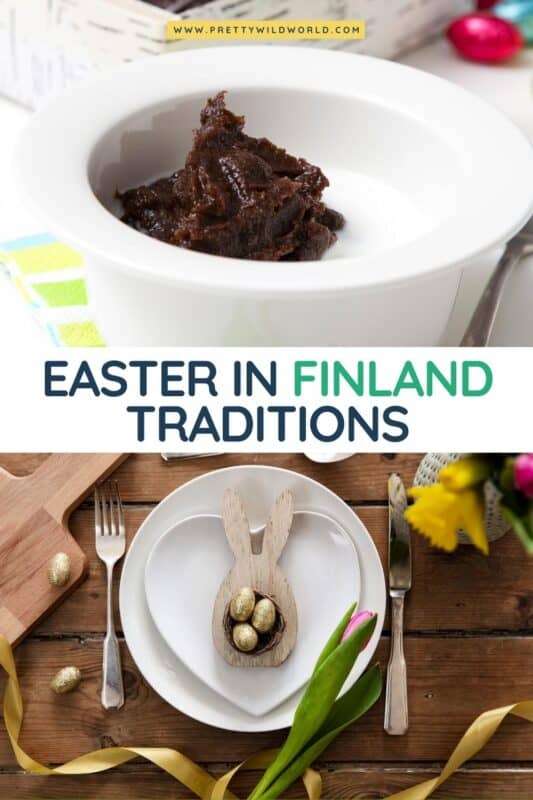
Quick Answer: Finnish Easter (Pääsiäinen) runs Maundy Thursday through Easter Monday with 2026 dates Good Friday April 3, Easter Sunday April 5, Easter Monday April 6. The standout Finnish tradition is virpominen, where children dress as Easter witches on Palm Sunday with painted freckles, scarves, and aprons, knocking on neighbors’ doors carrying decorated willow branches (pajunkissat), reciting “Virvon, varvon, tuoreeks terveeks, tulevaks vuodeks; vitsa sulle, palkka mulle!” in exchange for candy or coins. The traditional Easter table features mämmi (a centuries-old dark rye-and-malt pudding) and pasha (a creamy Orthodox cheese-and-cream dessert from eastern Finland). Rye grass sprouts (rairuoho) decorate Easter tables. Easter eggs and chocolate Easter eggs from Karl Fazer are widely consumed.
On Palm Sunday in Helsinki, small children dressed as Easter witches knock on apartment doors carrying decorated willow branches. The scene reads as Halloween costumes a week early to international visitors, but the Finnish Easter witch tradition (virpominen) predates Halloween by several centuries and runs as one of the country’s most-distinctive cultural moments.
Finnish Easter (Pääsiäinen) runs from Maundy Thursday through Easter Monday with the 2026 dates Good Friday April 3, Easter Sunday April 5, Easter Monday April 6. Good Friday and Easter Monday are public holidays alongside Easter Sunday. The cultural calendar covers virpominen on Palm Sunday (the Sunday before Easter), the traditional Easter food table featuring mämmi rye-pudding and pasha Orthodox cream dessert, Easter eggs both chicken and chocolate, and the distinctive Finnish rairuoho rye-grass sprouts as table decoration.
The Finnish Easter is meaningfully different from Mediterranean or American Easter traditions. The Lutheran-majority religious framing meets older Karelian Orthodox food traditions (pasha) and pre-Christian Finnish folk customs (virpominen Easter witches, willow branches as palm substitutes). The 12 traditions below cover the realistic Finnish Easter calendar from the Palm Sunday witch visits through the Easter Monday public holiday close.
Planning a Finland visit around the Easter holiday weekend with the Helsinki city anchor and the spring shoulder-season rates?
The Ultimate Europe Trip Planner sequences the Easter trip in one editable document.
Recommended Finnish Easter Essentials
Six items worth packing for the Finnish Easter trip or sourcing as Easter gifts; the rye flour and the Easter craft kit are the highest-value items for visitors wanting to recreate the Finnish Easter traditions at home.


Recommended blogs to read:
- things to do in Finland
- things to do in Helsinki
- Finnish phrases for travelers
- Finland with kids family travel guide
- spring in Finland
12 Finnish Easter Traditions for 2026
The 12 traditions below cover the realistic Finnish Easter calendar from Palm Sunday virpominen through Easter Monday close. Each entry notes the cultural context, the typical date or window, and the practical implication for visitors during the season.
1. Virpominen, The Easter Witch Tradition on Palm Sunday
Virpominen (the verb is virpoa, the noun form virvonta) is the Finnish Palm Sunday tradition where children dress as Easter witches and knock on neighbors’ doors carrying decorated willow branches. The children’s costumes typically include scarves wrapped over the head, aprons, painted freckles or rosy cheeks, and sometimes a small basket or sack for collecting treats. The custom runs across the entire country and remains widely practiced; most Finnish neighborhoods see substantial virpominen activity on Palm Sunday morning and afternoon. The tradition originated in Karelia (eastern Finland) and spread westward across the 19th and 20th centuries; the modern practice is fully secular and family-friendly rather than religious.
Read also: things to do in Rovaniemi for the broader Finnish family-folk-tradition context that the virpominen Easter witch costume belongs to.
2. The Traditional Virpominen Rhyme “Virvon, varvon…”
The traditional virpominen rhyme is the spoken-or-sung exchange at every doorstep visit: “Virvon, varvon, tuoreeks terveeks, tulevaks vuodeks; vitsa sulle, palkka mulle!” The rough English translation runs “I wave a twig for a fresh and healthy year ahead; a branch for you, a treat for me!” The willow branch is gifted to the household; the children receive candy or small coins (typical EUR 1 to EUR 3 per visit) in return. Variations of the rhyme exist across Finnish regions; the core wish for health and good fortune in the coming year is consistent. The rhyme is one of the most-widely-known Finnish folk verses; almost every Finnish-raised adult can recite it from memory.
Read also: Santa Claus Village Rovaniemi for the broader Finnish family-folk-tradition context that virpominen belongs to alongside the Joulupukki year-round visitor experience.
3. Pajunkissat, Decorated Willow Branches
Pajunkissat (literally “willow cats,” named for the soft fuzzy buds resembling cat paws) are the willow branches at the center of the virpominen tradition. Children gather the branches from wild willow shrubs in the weeks before Palm Sunday or buy them at Finnish supermarkets and craft stores. The decoration runs colorful crepe-paper streamers, feathers, painted Easter eggs, ribbons, and small paper figures attached with thread. Schools and daycare centers run pajunkissat decoration workshops in the week before Palm Sunday; supermarkets stock the craft supplies seasonally. The willow choice substitutes for Mediterranean palm branches used in the Catholic and Orthodox Palm Sunday traditions; willow is one of the first plants to bloom in the northern climate, making it the natural Finnish symbol of spring renewal.
Read also: Midsummer Juhannus in Finland for the broader Finnish nature-and-renewal cultural arc that pajunkissat begin.
4. Origins, Russian Orthodox Plus Swedish Folklore Hybrid
The Finnish Easter witch custom grew from two older traditions that fused across the centuries. The first is the Russian Orthodox Easter ritual where willow twigs symbolize the palms laid before Jesus on Palm Sunday; this tradition reached eastern Finland (Karelia) through the long Russian Orthodox presence in the region. The second is a Swedish-and-Finnish folk tradition where children dressed up and went door-to-door to mock the earlier fears that evil witches roamed during the period between Good Friday and Easter Sunday. The two traditions merged into the modern Finnish virpominen during the 19th century. The Easter witch costume itself parodies the witches of folk fear; the Palm Sunday timing comes from the Orthodox willow-as-palm tradition.
Read also: Sami culture in Finland for the broader Finnish-and-Karelian cultural heritage context that the Easter witch tradition belongs to.
5. Mämmi, Dark Rye-and-Malt Pudding with Cream and Sugar
Mämmi is the central Finnish Easter food: a dark dense rye-and-malt pudding traditionally served cold with cream and sugar. The recipe uses rye flour, malted rye, water, and salt fermented and baked slowly over 6 to 8 hours; the result is a slightly sweet earthy-tasting pudding with the dense texture between a custard and a wet bread. Mämmi has been documented in Finnish food history since at least the 13th century. The traditional serving format adds a generous pour of fresh cream and a sprinkling of sugar; some modern versions use vanilla cream or ice cream. Mämmi divides opinion sharply: many Finns love it, others find the texture-and-taste challenging. Visitors should try it once at minimum; the Hakaniemi Market Hall and most Finnish supermarkets sell traditional birch-bark-pattern cartons through Easter season.
Read also: best restaurants in Helsinki for the restaurants that serve traditional mämmi alongside the broader Finnish Easter menu through April.
6. Pasha, Karelian Orthodox Cream-and-Cheese Dessert
Pasha is the second signature Finnish Easter dessert, a creamy Orthodox tradition particularly common in eastern Finland with Karelian heritage. The recipe combines quark or cream cheese, butter, cream, sugar, vanilla, almonds, and dried fruits (typically candied citrus peel, raisins, and apricots) pressed in a pyramid-shaped mold lined with cheesecloth and left to drain for 24 to 48 hours before serving. The Orthodox tradition uses pasha as part of the Easter Sunday celebratory table; the Finnish secular adoption extended the dessert across the broader population in regions with significant Karelian Orthodox heritage including Joensuu, Kuopio, and the broader eastern lakeland. Pasha appears in Finnish supermarkets and bakeries through Easter season; the homemade version is one of the most-distinctive eastern Finnish family Easter recipes.
Read also: things to do in Joensuu for the Karelian eastern-Finland cultural context that pasha belongs to.
7. Easter Ham and Side Dishes
The Finnish Easter dinner often features ham as the main protein, prepared similarly to the Christmas joulukinkku but typically smaller and less elaborate. Side dishes include the same root-vegetable casseroles (lanttulaatikko mashed rutabaga, porkkanalaatikko mashed carrot) familiar from Christmas, plus spring-season additions like cucumber salad and new-potato dishes when seasonally available. Boiled hard-cooked eggs feature prominently as both food and table decoration. The overall Easter dinner runs less elaborate than the Christmas Eve feast but maintains the family-gathering scale and the multi-course pacing across the late-afternoon to early-evening window. Easter Sunday is the standard family-dinner day; Good Friday and Easter Monday run quieter.
Read also: Christmas in Finland traditions for the comparison Christmas Eve feast format that the Easter dinner echoes at smaller scale.
8. Easter Eggs, Chicken Eggs and Karl Fazer Chocolate Eggs
Easter eggs in Finland run across two formats. Traditional chicken eggs are hard-cooked and decorated by families in the days before Easter; the standard format runs natural dyes (yellow onion skins for orange-yellow tones, beetroot for pink) plus painted decoration with paints or markers. Decorated eggs appear on Easter tables and in window displays. Chocolate eggs from Karl Fazer (Finland’s flagship chocolate company since 1891) are the modern Easter gift format; the iconic Fazer Mignon egg (a real eggshell filled with hazelnut chocolate praline) has been produced since 1896 and remains one of the most-recognized Finnish Easter products. Smaller chocolate eggs from Fazer and other Finnish chocolatiers appear in supermarkets through March and April.
Read also: is Finland expensive for the broader Finnish retail and food pricing context including the seasonal chocolate market.
9. Rairuoho, Rye Grass Sprouts on the Easter Table
Rairuoho (rye grass sprouts) is one of the most-distinctive Finnish Easter decorations: a small dish or pot of growing bright-green rye grass placed on the Easter table as a symbol of spring renewal and the resurrection theme. Finnish families plant rye seeds in shallow dishes about 2 weeks before Easter Sunday; the sprouts grow to about 5 to 10 cm tall by the holiday, producing a vivid green grass tuft. Many Finnish kindergartens and primary schools run rairuoho planting projects with children. The tradition combines pre-Christian Finnish spring symbolism with the Christian Easter resurrection imagery; the bright green sprouts against the dark March or April Finnish window light create a powerful visual marker of spring’s return. Most Finnish supermarkets sell rye seeds in small Easter packets starting in early March.
Read also: Mökki cottage culture in Finland for the broader Finnish nature-and-spring-renewal cultural context that rairuoho belongs to.
10. Religious Customs, Maundy Thursday Through Easter Monday
The Finnish Easter religious calendar follows the Lutheran majority-church framework with Maundy Thursday (Kiirastorstai) opening the formal Easter week, Good Friday (Pitkäperjantai) as the most-solemn day, Easter Sunday (Pääsiäissunnuntai) as the central celebration of the resurrection, and Easter Monday (Toinen pääsiäispäivä) as the closing public holiday. The Helsinki Cathedral runs multiple Easter services across the weekend; the Easter Sunday morning service is broadcast on Finnish national television. Orthodox congregations in eastern Finland (Kuopio, Joensuu) run the parallel Orthodox Easter calendar which sometimes falls on a different week than the Lutheran calendar. Modern Finnish observance is largely secular for most families with religious customs holding particular weight among older generations and in eastern Karelian-Orthodox communities.
Read also: art museums in Helsinki for the cultural-and-religious-art context including the Sinebrychoff Art Museum’s Old Master collections.
11. Pääsiäisloma, Easter School Holidays
Finnish schools close for pääsiäisloma (Easter holiday) typically from Maundy Thursday through Easter Monday giving children a 4 to 5-day break. The school holiday combined with the Good Friday and Easter Monday public holidays makes the Easter weekend a substantial family vacation window; many Finnish families travel to summer cottages (mökki) for the Easter weekend, often combining Easter family gatherings with the late-spring sauna-and-thaw activities. Easter is one of the busier Finnish domestic-tourism weekends with hotel pricing in popular destinations (Lapland ski resorts, Saimaa Lakeland) running noticeably higher than the surrounding weeks. International visitor numbers also rise across the Easter weekend; book Helsinki and Lapland accommodation 4 to 8 weeks ahead of the Easter dates.
Read also: things to do in Helsinki in winter for the late-winter Helsinki Easter context that overlaps with the early-April holiday weekend.
12. Regional Variations, Western vs Eastern Finland Easter Customs
Finnish Easter customs vary noticeably across the country, reflecting deeper historical religious and cultural divisions. Western and central Finland (Helsinki, Tampere, Turku, the broader Ostrobothnia coast) lean toward the Lutheran-majority customs with mämmi as the central dessert, traditional Easter ham dinner, and the standard virpominen Palm Sunday witch tradition. Eastern Finland (Kuopio, Joensuu, the broader Karelian region) keeps the older Russian Orthodox traditions stronger with pasha as a central dessert alongside mämmi, more-pronounced Easter church services, and longer-running Easter food customs. Lapland’s Sami communities (Inari, Utsjoki) maintain distinct northern Easter traditions combining Lutheran calendars with older indigenous practices. The variations make the Finnish Easter trip particularly rewarding for visitors willing to explore beyond the standard Helsinki-anchor format.
Read also: Kuopio Lakeland guide for the eastern-Karelian-Orthodox Finland context that holds the strongest pasha and Orthodox-Easter traditions.
Planning the Easter weekend Finland trip combining Helsinki city with a mökki cottage extension?
The Ultimate Europe Trip Planner sequences the Easter weekend trip in one editable document.
Frequently Asked Questions
When is Easter in Finland in 2026?
Easter 2026 falls Good Friday April 3, Easter Sunday April 5, Easter Monday April 6. Maundy Thursday (April 2) opens the formal Easter week. Palm Sunday (the Sunday before Easter, March 29 in 2026) anchors the virpominen children’s witch tradition. Schools close from Maundy Thursday through Easter Monday for the standard pääsiäisloma 4 to 5-day break.
What is virpominen?
Virpominen is the Finnish Palm Sunday tradition where children dress as Easter witches with scarves, aprons, and painted freckles, knocking on neighbors’ doors carrying decorated willow branches (pajunkissat). The children recite “Virvon, varvon, tuoreeks terveeks, tulevaks vuodeks; vitsa sulle, palkka mulle!” (I wave a twig for a fresh and healthy year ahead; a branch for you, a treat for me!), exchanging the willow branch for candy or small coins.
What is mämmi?
Mämmi is the central Finnish Easter food: a dark dense rye-and-malt pudding traditionally served cold with cream and sugar. The recipe uses rye flour, malted rye, water, and salt fermented and baked slowly over 6 to 8 hours. Mämmi has been documented in Finnish food history since at least the 13th century. The taste-and-texture divide opinion sharply; visitors should try it once at minimum. Most Finnish supermarkets sell traditional birch-bark-pattern cartons through Easter season.
What is pasha?
Pasha is a creamy Orthodox Easter dessert particularly common in eastern Finland with Karelian heritage. The recipe combines quark or cream cheese, butter, cream, sugar, vanilla, almonds, and dried fruits pressed in a pyramid-shaped mold lined with cheesecloth and left to drain for 24 to 48 hours. Pasha is the second signature Finnish Easter dessert alongside mämmi, particularly common in Joensuu, Kuopio, and the broader eastern lakeland regions with significant Karelian Orthodox heritage.
Are Finnish shops open during Easter?
Most Finnish shops close on Good Friday, Easter Sunday, and Easter Monday with reduced hours on Maundy Thursday and the Saturday between Good Friday and Easter Sunday. Hotels, gas stations, and some chain restaurants remain open across the holiday. Plan trips to stock up on essentials before Maundy Thursday afternoon. Public transport runs reduced Sunday schedules on Good Friday, Easter Sunday, and Easter Monday. Most museums close on the Easter holiday public days; verify hours on the museum’s own website before visiting.
Is Easter a good time to visit Finland?
Yes for travelers wanting the late-spring trip combining the Easter cultural calendar with the Lapland spring-skiing window. Lapland resorts (Levi, Yllas, Ruka) run their final-month-of-season operations across Easter with excellent snow conditions and substantially longer daylight than midwinter. Helsinki runs the spring shoulder-season pricing with the museums and city attractions accessible. The trade-off is the public holiday closures on Good Friday and Easter Monday; plan museum visits and shopping for the surrounding regular days.
Key Takeaways
- Easter 2026: Good Friday April 3, Easter Sunday April 5, Easter Monday April 6; virpominen Palm Sunday March 29.
- Virpominen is the Finnish Palm Sunday Easter-witch tradition with decorated willow branches (pajunkissat) and the traditional Virvon-varvon rhyme.
- Signature Easter foods: mämmi dark rye pudding (with cream and sugar) and pasha Karelian Orthodox cream-and-cheese dessert in eastern Finland.
- Distinctive Finnish Easter table decoration: rairuoho rye grass sprouts grown in dishes for 2 weeks before Easter as spring-renewal symbol.
- Easter eggs run as both decorated chicken eggs and Karl Fazer chocolate eggs; the Fazer Mignon egg (real eggshell filled with hazelnut praline) has been produced since 1896.
Final Thoughts
Finnish Easter blends Lutheran-majority customs with Karelian Orthodox food traditions and pre-Christian folk practices into a distinctive culture: the virpominen Easter-witch tradition on Palm Sunday, the mämmi-and-pasha dual Easter dessert table, the rairuoho rye-grass spring-renewal decoration, and the Karl Fazer chocolate Easter eggs alongside the traditional decorated chicken eggs. The regional split between western Lutheran customs and eastern Karelian Orthodox customs adds depth that rewards the deeper Finland Easter trip. For travelers planning the Easter visit combining the cultural calendar with the Lapland spring-skiing window or the Helsinki city anchor, the spring in Finland guide and the things to do in Finland guide connect Easter into the broader spring trip plan.