Here is a detailed list of the best Thailand culture and traditions every tourist should see or experience for a meaningful adventure.
Most tourists in the world would more likely associate Thailand with Buddhism, being its dominant religion. For centuries, Buddhism has played an influential role in Thai economic, political, and social affairs.
In almost every province and community, the locals celebrate festivals dedicated to their devotion. Although these are mostly religious occasions, tourists are welcome to participate in singing and dancing. There are so much fun and intensity that tourists can’t help but get wild. Fun is a buzzword here.
But here is the catch. Thailand is much more to its Buddhist roots and festivals. Speaking of culture, tourists will be surprised to find out more. After all, the country hosts diverse ethnic groups with unique cultures and traditions.
Hiking to the Hill Tribes, for example, will let tourists experience diversity, away from the usual hype of Bangkok.
Get to experience the richer Thailand culture and traditions through these occasions.
A Detailed List of the Best Thailand Culture and Traditions to Experience
Rockets for Rain – Bun Bang Fai (Rocket Festival)

The Northeastern provinces of Isaan, Chiang Mai, and Yasothon frequently experience dry climate, affecting crop production. So the locals celebrate this annual festival every May to implore the god Phaya Thaen to provide rains.
As part of the celebration, the locals create projectiles out of bamboo, some of which have a length of 20 feet. Using a concoction of charcoal and sulfur, these projectiles are then launched to the sky, hoping Phaya Thaen would respond with rains.
The team with the highest, straightest, and farthest rocket hit will bring home a prize worth 10 000 baht. Aside from the competition, there are also beauty pageants, cultural performances, and street shows.
[irp]
Monkey Buffet Festival Celebration in Lopburi

Lopburi is home to more than 4000 monkeys who have been coexisting with the locals since the 6th century. Local tradition has it that a monkey named Hanuman saved a god’s daughter from a demon; thus, monkeys became respected since then.
The locals believe that Hanuman brings prosperity and good fortune. That is why they conduct a massive buffet at the Phra Prang Sam Yod temple exclusively for the thousands of monkeys.
As the monkeys feast on the laid out food, humans watch them and anticipate for good karma. The locals also hold a parade while wearing monkey costumes. It’s one of the most popular Thai traditions.
[irp]
Chiang Mai Yi Peng Lantern Festival

What is it like to see the sky illuminating as thousands of lanterns dot the inky stratosphere? That’s an answer tourists will know when they attend the Chiang Mai Yi Peng Lantern Festival.
There are two lantern events in the province, namely, Loy Krathong and Yi Peng. Loy Krathong is done in respect of the water goddess. At the same time, Yi Peng symbolizes a person releasing his/her worry and anxiety.
The lanterns are paper hot-air balloons locally known as khom loi. The lantern release is one of the most iconic Thailand cultural experiences.
[irp posts=”24898″ name=”Top 10 What NOT to do in Thailand When You Visit”]
Mekong Naga Fireballs

Legend has it that serpent-like creatures known as Phaya Naga, dwell in the deep parts of the mighty Mekong River. They are believed to possess divine powers and are said to be responsible for a rare occurrence on the Mekong River’s surface.
During the Buddhist Lent in October, reddish-pink balls of light emerge from the Mekong River surface and soar to the sky.
The locals believe that these are mythical works of the Naga as there are no human interventions involved. Scientists suggest that the rising balls of light are a result of the combustion of flammable sulfur emerging from the Mekong River. Still, it’s a bizarre phenomenon worth seeing.
[irp posts=”24458″ name=”When is the Best Time to Visit Thailand?”]
Vegetarian Festival – Not for the Fleshy

Although it is dubbed as a vegetarian festival, the occasion is not all about the vegan lifestyle. It is merely a period of abstinence from meat as part of achieving purification and good health for both the mind and the body.
It is observed during the first nine days of the 9th Lunar Calendar Month, especially in Phuket. During this period, devotees abstain from meat-laden meals, including bulbous plants such as chives and onions.
Even restaurants and food stalls shift their menus to cater to demand. As part of the celebration, hundreds of shamas parade the streets while performing self-mutilation, such as walking on burning hot coals and piercing the cheeks with sharp objects.
Surprisingly, they emerge from the rituals almost unscathed! Today, it has become one of the most crowd-drawing Thai cultures.
[irp posts=”25046″ name=”Thailand Cuisine: Top 15 Best Food in Thailand”]
The Ancient Culture of the Mon People
The Mon ethnic groups are considered one of the earliest inhabitants of Thailand. According to scholars, they originated from China, Mongolia, and India and settled to Thailand’s northern regions near the border with Burma. For centuries, the Mon endured persecution and expulsion from their ancestral territories.
During the reign of King Rama IV, many Mon were allowed to establish villages on undeveloped forest lands. Tourists can visit these villages to experience the vanishing life of the Mon people.
Moreover, they can explore the surrounding rich forests and play with the elephants. The Mon people showcase some of the most authentic Thai traditions and culture.
[irp posts=”24894″ name=”Top 31 Things You Should Know Before Visiting Thailand”]
Phi Ta Khon (Ghost Mask Festival)

A local tradition chronicles that Buddha was once a prince who embarked on a long journey. He was presumed to have died. To cut a long story short, Buddha came home alive, and the whole kingdom threw a celebration for him.
That gave birth to the Phi Ta Khon or Ghost Mask Festival, which has become an annual celebration. A highlight of the occasion is the parade of participants with spooky masks and elaborate costumes.
As they parade, they create all sorts of noises and dances to awaken the adjacent Mun River’s spirit. They believe that these spirits protect the community and shower blessings.
[irp posts=”24711″ name=”Top 20 Beautiful Temples in Thailand”]
Salak Yom Procession for the Dead
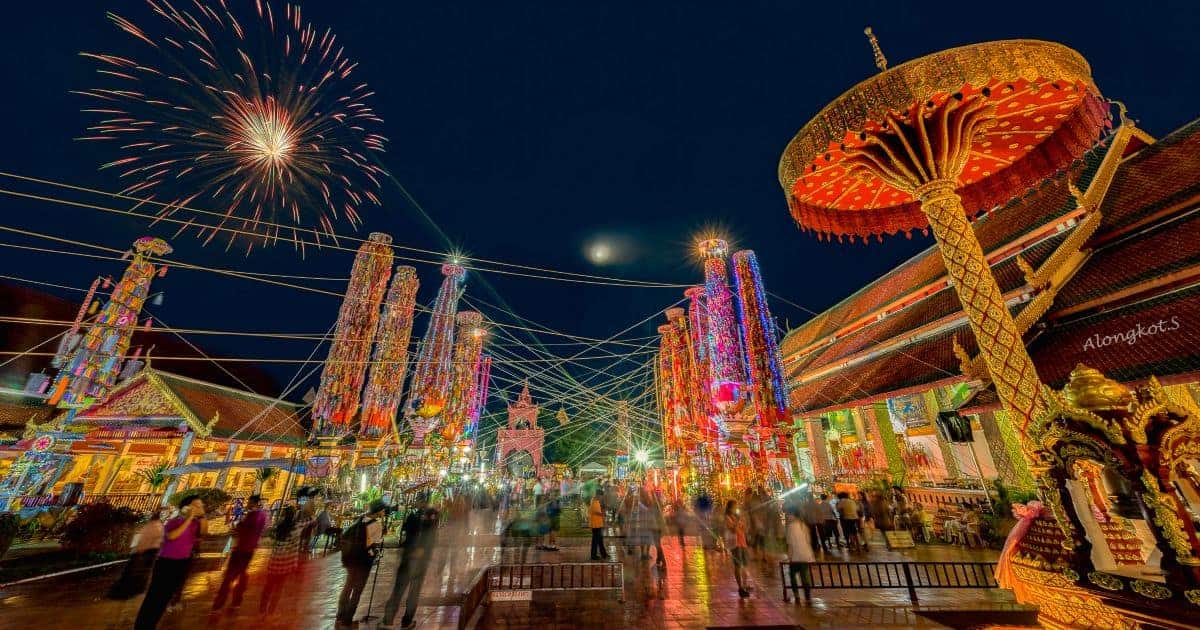
Thailand abounds with a canonical and tree-like structure known as salak, which can often rise to more than two meters high. The locals believe that consecrating these trees to the monasteries will bring their gifts to the afterlife to be possessed by their deceased loved ones.
The festival is held every September. During this time, the locals parade elaborate salaks with their saturated and colorful plumes. It’s one of the unique Thailand traditions and celebrations.
[irp posts=”25079″ name=”Top 30+ UNIQUE Things to do in Thailand”]
Bo Sang Handmade Umbrella Festival
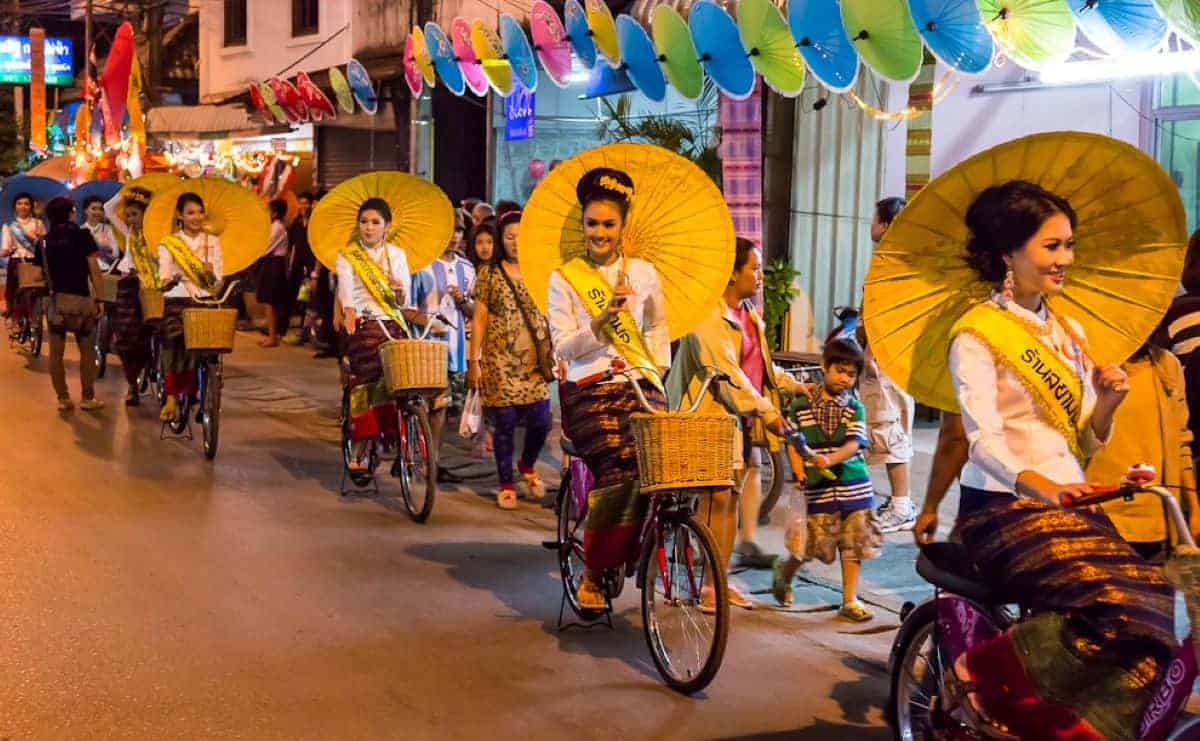
Legend has it that in ancient times, a venerable monk taught the locals of Bo Sang how to make umbrellas to serve as their livelihood. In gratitude to the monk, the locals have been celebrating a festival showcasing their most beautifully-designed umbrellas.
They make use of traditional materials such as bamboo wood and saa paper to create each umbrella. The festival takes place from January 18-20 every year.
[irp]
Loy Krathong’s Value of Water

The Loy Krathong Festival showcases how the Thai value the centrality of water to their survival and culture. During the festival, thousands of people in various locations release krathongs into lakes, rivers, and ponds until these become sights of flickering light beacons.
The locals believe that doing so will appease the water goddess. The activity also serves as their symbolic penance for polluting the freshwater bodies.
Now that we’ve got a list of the best Thailand culture and traditions, it’s time to level up your adventure by immersing in one of these. These are experiences that every tourist will surely love and reminisce for a lifetime.
[irp posts=”26405″ name=”Top 10 Best Things to Do in Thailand with Families”]