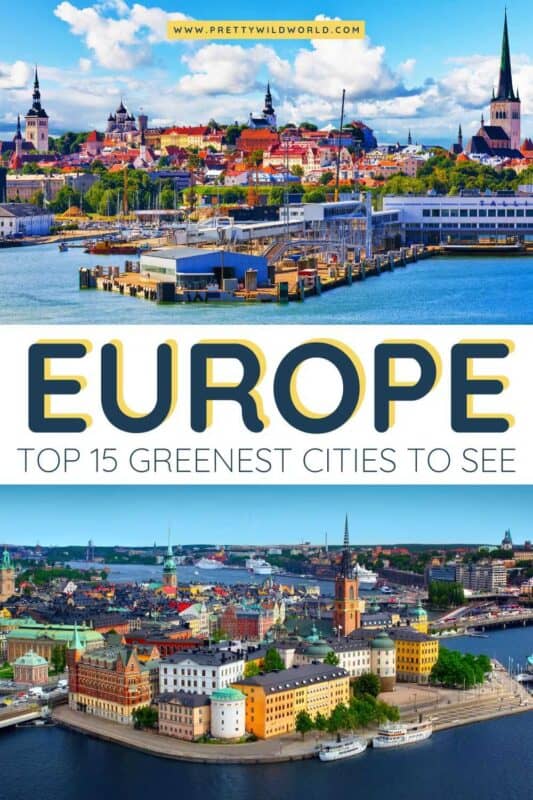
Quick Answer: The greenest cities in Europe in 2026 are crowned by Guimarães as European Green Capital, with Águeda (Portugal) and Vaasa (Finland) winning the Green Leaf Award. Heilbronn (Germany) is already announced as 2027 European Green Capital. The 2026 Green City Index puts Oslo first, Vilnius second and Helsinki third. Past Green Capital winners worth the trip include Stockholm, Copenhagen, Bristol, Ljubljana, Lisbon, Lahti and Vilnius.
Last updated: May 2026 · Guimarães Green Capital 2026 program and Green Leaf 2026 winners verified May 2026.
If you care even a little about how your travel affects the planet, Europe’s greenest cities should be on your radar. We’re talking places where bikes outnumber cars, where the public transit runs on renewables, where the air quality is so good you can actually feel it after a few days.
Copenhagen. Oslo. Stockholm. Helsinki. Vilnius. And this year’s headliner, gorgeous medieval Guimarães in northern Portugal, the 2026 European Green Capital.
In this post, I’m sharing the cities to visit if you want a sustainable trip that doesn’t feel like a sacrifice. It can feel like Guimarães at sunset, honestly.
Sustainable Europe Travel Kit
A green-cities Europe trip wants kit that matches the values. A reusable bamboo cutlery set for the picnic lunches in Oslo parks. A collapsible silicone water bottle because tap water is excellent in every Green Capital city. A solar panel travel charger for the train days. An organic cotton travel towel for the Helsinki sauna culture. Eco-friendly laundry strips so you don’t ferry detergent bottles. A proper sustainable Europe travel guide. Six picks below carry the kit.


| Award status | City | Population |
|---|---|---|
| 2026 Green Capital | Guimarães, Portugal | 156,830 |
| 2026 Green Leaf | Águeda, Portugal & Vaasa, Finland | 47k / 67k |
| 2027 Green Capital (announced) | Heilbronn, Germany | 126,000 |
| 2025 Green Capital | Vilnius, Lithuania | 590,000 |
| 2024 Green Capital | Valencia, Spain | 800,000 |
| Green City Index 2026 #1 | Oslo, Norway | 700,000 |
Which Cities Crown the 2026 Green Capital Year?
Three cities hold the 2026 European Green Awards. Guimarães wears the European Green Capital crown. Águeda and Vaasa hold the European Green Leaf for smaller cities (each receiving €200,000 in EU funding). All three earned their titles on the back of the same 12-indicator framework: air quality, water, climate adaptation, mobility, biodiversity, waste, noise, governance, green growth, land use, energy and citizen engagement. The 2026 calendar of events in each city is the most useful visitor hook because each award city runs a full year of public-facing programming.
1. Guimarães, Portugal, European Green Capital 2026
The medieval birthplace of Portugal (the country’s first capital, founded around the castle in the 12th century) holds 156,830 residents and won the 2026 European Green Capital crown on the back of a deep sustainable-mobility program. 97% of residents enjoy “good” or “very good” air quality measurements. The Spring Festival in late March includes a 10-kilometer green-route race through the historic UNESCO core. Spring Forward dance festival in April. Green Week in June. Mobility Week in September. The Citania de Briteiros Iron Age settlement on a nearby hilltop adds a deep-time historical angle.
Train from Porto runs 90 minutes. Stay at Hotel da Oliveira on the central square or at the Pousada Mosteiro de Guimarães (a converted 12th-century monastery). Eat at Restaurante Histórico da São Martinho or at Hool for the modern Portuguese. Three days for the city; four with day trips to Braga (15 minutes by train) or to Citania de Briteiros.
Read also: things to do in Portugal and places to visit in Western Europe.
2. Águeda, Portugal, European Green Leaf 2026
A small Portuguese town (population 47,000) on the Águeda River south of Porto won the Green Leaf 2026 for its waste-management and biodiversity work, plus its annual AgitÁgueda umbrella-art festival, when the town center streets are covered in suspended umbrellas of every color. The festival runs in July and August and has become one of the most-Instagrammed seasonal art installations in Portugal. The Pateira de Fermentelos wetland reserve outside town is a Natura 2000 site protecting one of the largest natural lagoons in the Iberian peninsula.
Train from Aveiro runs 25 minutes. Visit during the umbrella festival for the visual. Stay at Hotel Conde de Águeda. Eat at Adega de Sandomil for the regional Beira Litoral. Two days.
Read also: things to do in Portugal and hidden gems in Europe.
3. Vaasa, Finland, European Green Leaf 2026
The bilingual (Finnish-Swedish) coastal city on the Gulf of Bothnia holds 67,000 residents and won the 2026 Green Leaf for its EnergyVaasa cluster: about 160 companies and 14,000 employees working on energy technology and renewable energy R&D. The Kvarken Archipelago UNESCO World Heritage site (the only UNESCO Natural Heritage in Finland) sits offshore with 5,600 islands formed by post-glacial rebound. The city itself has 250 kilometers of cycle paths and one of the highest per-capita rates of electric vehicle adoption in the Nordics.
Train from Helsinki runs 4 hours. Fly direct from Helsinki in 1 hour. Stay at Hotel Astor in the city center. Eat at Strampen for the harbor view. Two days for the city; three with a Kvarken Archipelago day trip.
Read also: things to do in Finland, places to visit in the Nordics, and things to do in vaasa.
Who’s Announced for the 2027 Green Cohort?
The European Commission announced the 2027 winners in October 2025. Heilbronn (Germany) takes the Green Capital crown for 2027. Assen (Netherlands) and Siena (Italy) take the Green Leaf for smaller cities. Visiting any of these three in late 2026 catches the city in pre-launch mode, when infrastructure is being upgraded but visitor crowds haven’t arrived. This is the smart-travel move: get there a year ahead of the title.
4. Heilbronn, Germany, 2027 European Green Capital
A wine-and-tech city of 126,000 in Baden-Württemberg on the Neckar River won the 2027 crown on the back of its experimenta science museum (Germany’s largest), its waste-heat district-heating system that supplies 70% of public buildings, and its post-2010 Stadtmitte revitalization. The first German Green Capital since Essen (2017). The Wein Lese week each September pours the Württemberg wines from the hills around the city. Late-2026 visits catch the city in pre-launch infrastructure upgrade mode.
Train from Stuttgart runs 40 minutes. Stay at the Insel-Hotel for the river view. Eat at Erlebnis Goldener Adler. Visit the experimenta and walk the Theodor-Heuss-Platz. Two days.
Read also: things to do in Germany and unique places to visit in Europe.
Which Past Green Capitals Are Still Worth the Trip?
Six past Green Capital winners stand out as genuinely visitable destinations for green-conscious travelers. Stockholm (2010, the first winner), Copenhagen (2014), Bristol (2015), Ljubljana (2016), Lisbon (2020), Vilnius (2025). Each maintained or built on the green infrastructure that won them the award. Each delivers a coherent eco-travel experience that doesn’t require you to think about sustainability while you’re there because the city does it for you.
5. Stockholm, Sweden, 2010 Green Capital
The first European Green Capital ever crowned. Stockholm sits on 14 islands connected by 57 bridges, with 30% of the city area as parks and water. The Hammarby Sjöstad district (built 2000-2017) is the most replicated sustainable-neighborhood model in the world: closed-loop waste, district heating from sewage, green roofs everywhere. The Tunnelbana metro system runs on 100% renewable electricity. The Royal National City Park, the world’s first urban national park (1995), covers 27 square kilometers inside the city limits.
Stay in Södermalm for the design-and-cafe scene. Eat at Frantzén (3 Michelin stars) or Oaxen Krog for the modern Nordic. Three days.
Read also: things to do in Sweden, Stockholm itinerary, best bars in stockholm, best cafes in stockholm, and best museums in stockholm.
6. Copenhagen, Denmark, 2014 Green Capital
The most-cited bike city in Europe (62% of residents commute by bike) and the home of the carbon-neutral-by-2025 goal (achieved 99% as of late 2025). The Cykelslangen elevated bike bridge (2014) runs 235 meters over the harbor. The CopenHill ski slope on top of the Amager Bakke waste-to-energy plant (opened 2019) is a working dual-purpose building that nobody else has built. The Refshaleøen industrial-to-creative district holds the city’s best food markets (Reffen) and Noma restaurant.
Stay in Nørrebro or Vesterbro. Eat at Noma (book a year ahead), or at the simpler 108 in the same group. Rent a bike for the city. Four days.
Read also: things to do in Denmark, Copenhagen itinerary, best pubs and bars in copenhagen, cafes in copenhagen, and copenhagen fall outfits.
7. Bristol, UK, 2015 Green Capital
The UK’s most successful green city, with 50% of the city area as green space and the country’s first metro mayor explicitly elected on a climate-action platform (2017). The Bristol harbourside redevelopment turned former docks into a working waterfront with the SS Great Britain museum and the M Shed. The Banksy connection (the artist’s home city) and the surviving street-art trail through Stokes Croft pull the contemporary crowd. The Clifton Suspension Bridge (Brunel, 1864) is one of England’s great Victorian engineering monuments.
Train from London runs 1h 40min. Stay in Clifton or Stokes Croft. Eat at Casamia (one Michelin star) or at the simpler Pinkmans Bakery. Two days.
Read also: things to do in England and places to visit in Western Europe.
8. Ljubljana, Slovenia, 2016 Green Capital
The smallest European capital to win the Green Capital award (city center population 60,000, full city 295,000). The 2016 win followed a 2007 pedestrianization of the entire city center (no cars, only bikes and the small electric Kavalir vehicles for those with mobility issues). Tivoli Park covers 5 square kilometers and runs straight into the city center. The Ljubljanica River walking path stitches the small inner city together. The Bicike(LJ) bike-share system has 600 bikes at 60 stations.
Stay near the Triple Bridge for the central walkability. Eat at Druga Violina (the social-enterprise restaurant) or at Strelec on the castle hill. Three days.
Read also: things to do in Slovenia, best capital cities in Europe, things to do in ljubljana, and top day trips from ljubljana.
9. Lisbon, Portugal, 2020 Green Capital
The first southern European Green Capital, awarded for the 200% expansion of the bike-path network between 2017 and 2020 and the GIRA bike-share rollout. The Parque das Nações district (built for Expo 1998) is the city’s modern sustainable-design quarter. The trams (electric since 1901) are still the iconic transport. Lisbon’s 2020 Green Capital year coincided with the COVID lockdown, which compressed most of the program into 2021. Worth a return visit in 2026 to catch what the post-Capital year delivered.
Stay in Alfama or Príncipe Real. Eat at Alma (2 Michelin stars) or at the more casual Time Out Market. Four days.
Read also: things to do in Portugal, Lisbon itinerary, is lisbon worth visiting, and things to do in lisbon.
10. Vilnius, Lithuania, 2025 Green Capital
The last city to hold the Green Capital crown before Guimarães. Vilnius won the 2025 award on the back of district-heating decarbonization (90% of city heating now from biomass and waste-heat sources), the Neris River cleanup, and the bike-path network expansion across the Old Town. The Užupis micronation neighborhood (declared April 1997, see the unique-places-in-Europe post) sits across a small bridge. The Old Town UNESCO inscription (1994) is the largest preserved medieval old town in Eastern Europe.
Stay in the Old Town near St. Anne’s Church. Eat at Sweet Root for modern Lithuanian. Visit the Užupis Art Incubator. Three days.
Read also: things to do in Lithuania and best capital cities in Europe.
Which Cities Are Never-Awarded But Genuinely Green?
Four European cities have never held the Green Capital crown but consistently appear at the top of the alternative green-city rankings: Bern, Helsinki, Tallinn, Zurich. The Green Capital nomination process rewards cities that show recent improvement, which sometimes overlooks cities that have been quietly green for decades. These four fall in the latter category. They didn’t apply or they didn’t win the most recent cycle, but on the working green-quality-per-visitor metric they rank with the official winners.
11. Bern, Switzerland
The Swiss capital (population 135,000) sits inside a horseshoe meander of the Aare River and has 50% of its area as forest. The UNESCO-inscribed Old Town (1983) holds 6 kilometers of arcaded shopping streets, the longest covered walkway in Europe. Locals swim in the Aare from June through September; the city installed swimming-access platforms for the morning commute. The Bear Park beside the river (the city’s namesake animal) has lived bears in a 6,000-square-meter park since 1857.
Train from Zurich runs 1 hour. Stay at the Hotel Bellevue Palace. Eat at Restaurant zum Äusseren Stand. Two days.
Read also: things to do in Switzerland, places to visit in Western Europe, and is bern worth visiting.
12. Helsinki, Finland
The Finnish capital (population 660,000) holds the world’s most efficient district-heating system (97% of buildings on the network) and is on track for carbon neutrality by 2030, five years ahead of most European targets. The 2026 Green City Index puts Helsinki third behind Oslo and Vilnius. The Helsinki Central Library Oodi (opened 2018) is one of the best-designed public buildings of the past decade. The sauna culture is the strongest in Europe (one sauna per 3.5 residents nationally).
Stay in Kallio or Punavuori. Eat at Olo (1 Michelin star) or at the simpler Pjazza. Visit Löyly public sauna on the harbor. Three days.
Read also: things to do in Finland, places to visit in the Nordics, art museums in helsinki, best bars in helsinki, and best cafes in helsinki.
13. Tallinn, Estonia
The Estonian capital won the 2023 European Green Capital (the year before this post’s 2025 starting point but still recent). Free public transport for all residents since 2013, the first major European capital to do so. 60% green-space coverage. The Telliskivi Creative City complex hosts the country’s best food and gallery scene in a cluster of former industrial buildings powered by district biomass heating. The Old Town UNESCO inscription (1997) keeps the medieval core protected.
Stay at Hektor Container Hotel or at the Telegraaf in the Old Town. Eat at NOA on the coast. Three days.
Read also: things to do in Estonia, Tallinn itinerary, day trips from tallinn, helsinki tallinn ferry, and tallinn to helsinki ferry.
14. Zurich, Switzerland
The Limmat River runs perfectly clear through the city center and office workers swim in it during lunch breaks at the Frauenbad and Männerbad platforms (operating since 1837). The Üetliberg mountain at the city’s south edge has hiking trails accessible by S-Bahn train in 25 minutes. The Lake Zurich shoreline is one continuous public swimming area for 30 kilometers. Zurich’s per-capita CO2 emissions are 60% lower than Berlin’s despite the Swiss city being wealthier.
Stay near the Lindenhof or in the Kreis 5. Eat at Kronenhalle (the historic Zurich classic) or at IGNIV (1 Michelin star). Two days for the city, three with a Lucerne day trip.
Read also: things to do in Switzerland, Zurich guide, and things to do in zurich.
Where Does the 2026 Green City Index Top Three Sit?
The 2026 Green City Index (the post-Siemens commercial ranking that travel writers have started citing) puts Oslo first, Vilnius second, and Helsinki third for European capitals. Most travel blogs still cite the older 2012 Siemens Green City Index, which had Copenhagen first. The 2026 update reflects the post-2020 acceleration of policy in the Nordic capitals plus Vilnius’s win as 2025 Green Capital. Each city deserves a visit on the merits even if the Green Capital Award framework is the older, slower-moving, more rigorously-evaluated benchmark.
15. Oslo, Norway, 2019 Green Capital + 2026 Green City Index #1
The Norwegian capital won the 2019 Green Capital and currently holds the 2026 Green City Index top spot. Per-capita electric-vehicle adoption is the highest in the world (87% of new car sales in 2025). The Oslo Fjord runs straight into the city center, with the Sørenga sea bath built into the harbor itself for free public swimming. The Akerselva river park runs the length of the city from the fjord to Lake Maridalsvannet, with restored salmon runs since the 1990s cleanup. Population 700,000.
Stay in Grünerløkka or the new Vippetangen waterfront. Eat at Maaemo (3 Michelin stars) or at Hot Shop for the kebabs. Three days. Note: Oslo is also the most expensive city break in Europe for 2026 (€850 Post Office basket vs Sarajevo’s €288).
Read also: things to do in Norway, Oslo itinerary, best cafes in oslo, best museums in oslo, and best restaurants in oslo.
Green Cities Europe FAQ
Which European city is the greenest in 2026?
Depends on the measurement. By the European Green Capital Award: Guimarães, Portugal. By the 2026 Green City Index: Oslo. By per-capita carbon emissions: Stockholm or Zurich. By bike-commute percentage: Copenhagen (62%). By electric-vehicle adoption: Oslo. By district-heating coverage: Helsinki (97%). Each ranking captures a different definition of “green.”
What is the European Green Capital for 2026?
Guimarães, Portugal. Population 156,830. Won the award on the back of its sustainable-mobility program and the 97% of residents enjoying “good” or “very good” air quality. The 2026 calendar includes Spring Festival in March, Spring Forward dance festival in April, Green Week in June, and Mobility Week in September.
Is Guimarães worth visiting in 2026?
Yes, especially during the Green Capital event calendar weeks: late March (Spring Festival), April (Spring Forward), June (Green Week), September (Mobility Week). The medieval UNESCO core of the city is the birthplace of Portugal (founded around the castle in the 12th century). Train from Porto runs 90 minutes. Three days for the city, four with a Braga day trip.
Which city is greener, Oslo or Copenhagen?
By the 2026 Green City Index, Oslo (#1) edges Copenhagen. By the older Siemens 2012 Index, Copenhagen was first. By bike commute percentage, Copenhagen leads (62% vs Oslo’s 27%). By electric-vehicle adoption, Oslo leads (87% of new cars vs Copenhagen’s 35%). Both cities have eliminated the urban-pollution gap between Scandinavia and the rest of Europe.
What is the European Green Leaf Award?
A European Commission award for smaller cities (population 20,000 to 100,000) that complement the Green Capital Award (which is for cities over 100,000 population). Two cities win the Green Leaf each year, each receiving €200,000 in EU funding. The 2026 Green Leaf winners are Águeda, Portugal and Vaasa, Finland.
Which European city will be the Green Capital in 2027?
Heilbronn, Germany. Population 126,000. Announced October 2025. The first German Green Capital since Essen (2017). Won the award on the back of its district-heating waste-heat system, the experimenta science museum, and the Stadtmitte revitalization. Late-2026 visits catch the city in pre-launch infrastructure-upgrade mode.
Key Takeaways
- Guimarães, Portugal is the 2026 European Green Capital with population 156,830 and a year-long event calendar (Spring Festival, Spring Forward, Green Week, Mobility Week).
- Águeda (Portugal) and Vaasa (Finland) won the 2026 Green Leaf Award for smaller cities; each receives €200,000 in EU funding.
- Heilbronn (Germany) is announced as 2027 European Green Capital; late-2026 visits catch it in pre-launch mode.
- 2026 Green City Index puts Oslo first, Vilnius second, Helsinki third for European capitals.
- Past Green Capital winners worth the trip: Stockholm (2010), Copenhagen (2014), Bristol (2015), Ljubljana (2016), Lisbon (2020), Vilnius (2025).
- Never-awarded but consistently green: Bern, Helsinki, Tallinn, Zurich.
Lining the Green-City Trip Up With the Cities That Actually Walk the Talk
Green cities in Europe are no longer a fuzzy claim; they are a measurable ranking system with the European Green Capital Award as the gold standard. Guimarães 2026, Heilbronn 2027 (announced), Águeda and Vaasa as the 2026 Green Leaves. The Green City Index 2026 lifts Oslo, Vilnius and Helsinki to the top of the visitor-friendly rankings. The past Green Capital winners (Stockholm, Copenhagen, Bristol, Ljubljana, Lisbon, Vilnius) each maintained the infrastructure they won the award on. The never-awarded-but-green cities (Bern, Helsinki, Tallinn, Zurich) round out the list. Pick the trip that matches your green definition: the year’s headline winner, the past-winner trail, the Nordic policy benchmarks, or the under-50k Green Leaf surprises.