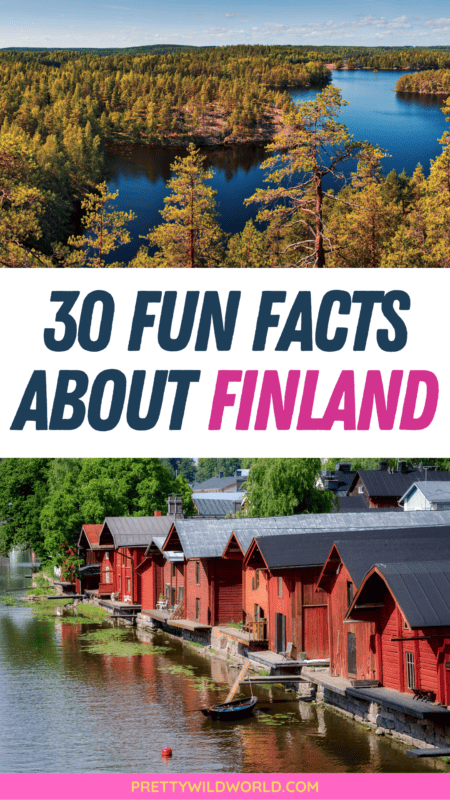
Quick Answer: Finland is the world’s happiest country (8 years running on the World Happiness Report through 2025), has more saunas than cars (3.3 million saunas for 5.5 million people), holds 188,000 lakes, owns 75% of its land as forest, gives every newborn a baby box, banned advertisements aimed at children under 13, runs the world’s only Air Guitar World Championships, hosts the Wife-Carrying World Championships, has zero homeless families with children since 2019, leads global education rankings, has the strongest passport in the EU for visa-free access (193 countries), and runs as the only country where Santa Claus has an official address (Joulukatu 1, Rovaniemi, 96930).
Finland has a way of producing facts that sound made up. The kind of trivia that gets shared in pub quizzes and gets fact-checked twice because nobody can quite believe a country could be that committed to baby boxes, sauna density, weird sports championships, and being statistically the happiest place on Earth. Most of them check out.
The list below covers the genuine, sourceable trivia rather than the recycled internet claims. Population figures use 2024 Tilastokeskus data. Happiness rankings cite the World Happiness Report (Sustainable Development Solutions Network). Sauna and lake counts use the Finnish Sauna Society and the Finnish Environment Institute. The Santa Claus postal address is the registered Finnish Posti delivery line. Where a “fact” floats around the internet without sourcing (the snowiest country claim, the most-coffee-consuming claim), the list flags it.
The 25 facts below land mostly in the “Finland is weirder than you think” category. The cultural symbols (sauna, sisu, Moomins, Nokia, Marimekko) sit on the matched What Is Finland Famous For guide. This one keeps to the trivia layer.
Planning a trip to Finland and want the trivia translated into a city-by-city route?
The Ultimate Europe Trip Planner builds the Finland itinerary around the sauna, lake, aurora, and Santa coordinates in one editable document.
Recommended Finland Trip Essentials
Six items worth packing for the Finland trip regardless of which trivia-driven coordinate you’re chasing first.


Recommended blogs to read:
- things to do in Finland
- best cities in Finland
- Finnish phrases for travelers
- is Finland expensive
- best time to visit Finland
25 Genuinely Surprising Facts About Finland
The facts below split into four loose groups: nature, society, sport-and-culture, and the genuinely weird. Each entry includes the underlying figure and where it came from.
1. Finland Has More Saunas than Cars
Finland counts roughly 3.3 million saunas for a population of 5.5 million. The country also has roughly 2.8 million registered passenger cars. That works out to roughly 1 sauna for every 1.7 people and more sauna installations than vehicles on the road. Most Finnish apartments built since the 1970s include a private sauna; nearly every house and cottage has at least one. Source: Finnish Sauna Society. Public sauna culture sits separately from private , Helsinki alone runs roughly 20 public saunas including Löyly, Allas Sea Pool, Sompasauna (the free outdoor sauna by the harbor), and the Yrjönkatu swimming hall (the oldest public swimming pool in the Nordic countries, with attached saunas open since 1928). Sauna etiquette runs nude-by-gender except in mixed-swimwear venues like Löyly.
Read also: Things to do in Helsinki · Ice swimming in Finland
2. Finland Holds 188,000 Lakes
The Finnish Environment Institute counts 188,000 lakes larger than 500 square meters across the country, plus an additional pool of smaller ponds and water bodies. The Lake Saimaa system alone runs as the fourth-largest lake in Europe by surface area at 4,400 square kilometers. The country’s “Land of a Thousand Lakes” nickname is dramatically understated by a factor of 188. The Lakeland (Järvi-Suomi) region covering central and eastern Finland holds the densest concentration; from above, the landscape looks more water than land. Lake Saimaa runs 4,400 square kilometers, comparable in size to small European countries. The lakes themselves freeze 4-5 months per year and the surfaces serve as ice-roads, snowmobile routes, and ice-skating tracks.
Read also: Lakes in Finland · Kuopio Lakeland guide
3. 75% of Finland Is Forest
Finland is the most-forested country in the European Union by percentage. Roughly 75% of the total land area is forest, totaling about 22.8 million hectares. The country’s annual forest growth rate exceeds the annual logging volume, which means Finland is one of the rare developed economies where the forest cover actively expands year-over-year. Source: Natural Resources Institute Finland (Luke). The dominant species are Scots pine, Norway spruce, and silver birch, with the boreal forest extending the full length of the country from the Russian border to the Swedish border. Roughly 60% of the forest is privately owned by individuals or families, an unusually high share by European standards. Every Finn has the legal Everyman’s Right (jokamiehenoikeus) to forage berries, mushrooms, and walk freely on this forested land.
Read also: National parks in Finland · Best hikes in Finland
4. Finland Has Won the World Happiness Ranking 8 Times in a Row
Finland has topped the World Happiness Report every single year from 2018 through 2025, eight consecutive years. The ranking covers 143 countries and weighs GDP per capita, social support, healthy life expectancy, freedom to make life choices, generosity, and perceptions of corruption. Finland scores particularly strongly on the social-support and freedom-to-make-life-choices factors. Source: Sustainable Development Solutions Network. The 2025 World Happiness Report attributes Finland’s consistent ranking to high trust in institutions, strong social safety nets, low corruption, and the cultural concept that Finns evaluate their lives on stability rather than excitement. Denmark, Iceland, Sweden, and the Netherlands typically fill the next slots, with the rest of the top 10 split between Northern European countries and a handful of Pacific economies.
Read also: Mökki cottage culture · Winter in Finland
5. Every Finnish Newborn Gets a Baby Box
The Finnish maternity package, run by the Kela social-insurance institution since 1938, gives every expecting mother a cardboard box containing clothes, sheets, toys, and a small mattress. The box itself doubles as the baby’s first bed. The maternity-package program is credited with helping reduce Finland’s infant mortality rate from one of the highest in Europe in the 1930s to one of the world’s lowest today. Roughly 95% of Finnish parents take the box rather than the alternative €170 cash payment. The 1938 launch tied the box to mandatory prenatal medical check-ups, which gave Finland the means to drop infant mortality through universal early prenatal care. The box contents update yearly through a public design competition. Most Finnish parents keep the box as a memento and many families have boxes spanning multiple generations of newborns sleeping in the same iconic cardboard bed.
Read also: Finland with kids · Easter in Finland
6. Santa Claus Has an Official Postal Address
The Finnish postal service Posti maintains an official Santa Claus address at Joulukatu 1, 96930 Arctic Circle, Finland. Letters arrive from roughly 200 countries every year and receive personalized replies postmarked from Santa’s Main Post Office at Santa Claus Village in Rovaniemi. The post office handles around 500,000 Santa letters per year. The Arctic Circle line itself crosses the village grounds and is marked on the ground. The post office runs year-round but volume spikes 50x in the November-December window. Letters arrive in dozens of languages and the post-office staff includes language specialists for personalized replies. The Santa Claus Village complex around the post office also includes Santa’s actual office for in-person meetings, husky and reindeer operators, and a hotel-and-cabin accommodation cluster.
Read also: Santa Claus Village · Meeting Santa in Rovaniemi
7. Finland Hosts the Wife-Carrying World Championships
Sonkajärvi in northern Savonia hosts the Wife-Carrying World Championships every July. The course runs 253.5 meters over a sand track with two dry obstacles and one water hazard. The champion wins his wife’s weight in beer, a prize calibrated to Finnish summer-festival sensibilities. The “wife” doesn’t have to be the contestant’s spouse but must be over 17 and weigh at least 49kg (carriers below the weight limit must add equivalent ballast). The championships have run since 1992 and have spawned regional qualifiers worldwide. Estonian teams traditionally dominate using the “Estonian carry” technique (the wife hangs upside-down on the husband’s back with her legs around his neck). The race draws thousands of spectators and runs alongside a wider festival weekend including live music, food stalls, and an after-party that lasts well into Sunday morning. The sport has spawned regional qualifiers in the US, UK, Australia, and India.
Read also: Midsummer Juhannus · Spring in Finland
8. Finland Runs the Air Guitar World Championships
Oulu has hosted the Air Guitar World Championships every August since 1996. The event runs over 3 days, draws competitors from roughly 30 countries, and awards prizes for best technique, best stage presence, and overall championship. The organizing committee’s official slogan claims that “wars would end, climate change would stop, and all the bad things would disappear, if all the people in the world played the Air Guitar.” The championships are free to watch. Past winners include Ochi “Dainoji” Yosuke from Japan and Justin “Nordic Thunder” Howard from the US. The competition has spawned a documentary film (Air Guitar Nation, 2006) and a Finnish-government endorsement as a cultural-export event. Past performances have included guitarists in elaborate costumes, themed routines around political commentary, and a notable performance by a former Finnish Defence Forces officer playing Iron Maiden in full military dress uniform.
Read also: Autumn in Finland · Summer in Finland
9. The Finnish Passport Is the Strongest in the EU
Finland’s passport ranks among the top 3 globally on the Henley Passport Index with visa-free or visa-on-arrival access to 193 destinations as of 2025. The Finnish passport ties with Singapore, Japan, and a handful of other European countries at the top of the global mobility rankings. Source: Henley & Partners. The passport ranking matters in practical terms for visa-free travel: Finnish citizens can enter the US, UK, Japan, Australia, and most of South America without applying for any visa in advance. The post-Brexit ranking shift moved the Finnish passport ahead of the UK passport for the first time in modern history, a reflection of EU membership compounding bilateral visa-waiver agreements.
Read also: ETIAS visa guide for Finland · Helsinki-Tallinn ferry
10. Finland Ended Family Homelessness
Finland is the only EU country where homelessness has dropped consistently for over a decade. The Housing First policy (Asunto Ensin), launched in 2008, gives the unhoused permanent housing first and addresses other support needs after stable accommodation is established. The country reported zero families with children sleeping rough in 2019; long-term homelessness has dropped by more than 70% from 2008 figures. Source: Y-Foundation Finland. The Housing First approach combines permanent housing with optional support services (addiction treatment, mental-health care, employment assistance) on an opt-in basis after housing is stable. The model has been studied and partially adopted by countries including Canada, France, and Australia. The Y-Foundation, the largest housing-provider implementing the model, reports that 80% of placed residents retain stable housing 1 year later.
Read also: Christmas in Finland · Where to stay in Helsinki
11. Finland’s Speeding Fines Scale with Income
Finland applies day-fine penalties for traffic violations, which scales the fine to the offender’s daily disposable income. The most-cited case is Reima Kuisla, a Finnish businessman fined €54,000 in 2015 for driving 23km/h over the limit. The system aims to make traffic fines equally punitive regardless of income. The lowest fine for the same violation can run €100 to €200 for an average earner. The day-fine system applies to a range of offenses beyond speeding, including drink-driving, assault, and white-collar fraud. The €54,000 fine to businessman Reima Kuisla in 2015 made global news and remains the most-cited example. The system has occasionally generated higher fines: a Nokia executive paid €116,000 in 2002 for speeding, and another driver paid €121,000 in 2023 for a similar offense.
Read also: Finland road trip routes · How to get around Finland
12. Finland Has the Highest Coffee Consumption per Capita
Finland consistently ranks #1 globally for coffee consumption per capita at roughly 12kg per person per year, compared to the US figure of 4.2kg per person per year. Finnish workers are legally entitled to two paid coffee breaks during a working day under most collective labor agreements. The dominant Finnish coffee is light-roast filter coffee, not espresso. Source: International Coffee Organization. Finnish coffee culture leans heavily toward filter brewing rather than espresso, with the kahvi tarjoilu (coffee service) tradition pairing coffee with sweet bread (pulla) at home gatherings. The country also ranks highly for per-capita milk consumption, with coffee and milk together forming the calorie backbone of the average Finnish breakfast. The fika tradition borrowed from Swedish neighbors but renamed kahvitauko applies similarly: a 15-minute social-coffee break every working day.
Read also: Best cafes in Helsinki · Best restaurants in Helsinki
13. Finland Has 35 National Parks
Finland operates 41 national parks (as of 2024) covering roughly 10,000 square kilometers of protected nature. The largest is Lemmenjoki National Park in Lapland at 2,860 square kilometers. The Everyman’s Right (jokamiehenoikeus) law allows free public access to private and public land for hiking, foraging, and camping, which makes the national-park system additive rather than restrictive. Source: Metsähallitus. The actual 2024 figure is 41 national parks. The Pallas-Yllästunturi park in Lapland is the most-visited at roughly 600,000 visitors per year. Urho Kekkonen National Park, named for the long-serving 20th-century Finnish president, runs as the second-largest at 2,550 square kilometers. National park entry is free everywhere, and the Metsähallitus agency maintains free-to-use shelters, fire-pits, and dry toilets across the park network.
Read also: Karhunkierros trail · Nuuksio National Park
14. Finnish Is Not Related to Swedish or Russian
Finnish belongs to the Uralic language family, not the Indo-European family that covers most European languages including Swedish, Russian, English, German, and French. Finnish’s closest major relative is Estonian, with Hungarian also in the Uralic family but distantly related. The language uses 15 grammatical cases, has no gendered pronouns (one word “hän” covers he/she/they), and has a vocabulary that is roughly 5% Swedish loan words and 0% Russian loan words despite centuries of rule by both empires. The 15 grammatical cases handle relationships English handles with prepositions: in, on, at, from, to, with, without. The cases attach as suffixes to noun stems, which produces words like “talossanikinkohan” (roughly: “I wonder if also in my house”). Estonia’s Estonian is mutually somewhat intelligible with Finnish for basic phrases, while Hungarian shares the family tree but with thousands of years of separate development.
Read also: Rauma UNESCO wooden town · Sami culture in Finland
15. Finland Was the First European Country to Give Women Full Voting Rights
Finland granted women full voting rights and the right to stand for parliamentary election in 1906, the first European country to do so. New Zealand and Australia preceded Finland in voting rights only but did not allow women to stand for office. In the 1907 election, 19 women were elected to the Finnish parliament, the first in the world. Finland also elected its first female prime minister (Anneli Jäätteenmäki) in 2003 and its first female president (Tarja Halonen) in 2000. Finland’s 1906 reform was part of the broader Grand Duchy of Finland constitutional reorganization within the Russian Empire, granting universal suffrage to both sexes simultaneously. The 19 women elected in 1907 represented multiple parties, including the Social Democrats and the Finnish Party. The country has since maintained strong gender-parity in elected positions, with the 2019 cabinet at one point including a female prime minister and four female party leaders of the five governing coalition parties.
Read also: Where to stay near Helsinki Airport · 7-day Finland itinerary
16. Heavy Metal Bands per Capita Is the World’s Highest
Finland has roughly 53 metal bands per 100,000 people, the highest density in the world (Sweden runs second at 27 per 100,000). Notable Finnish metal exports include Nightwish, HIM, Apocalyptica, and Lordi (the Eurovision 2006 winners who became the first hard-rock act to win the contest). The country’s metal scene has been actively cultivated since the 1990s with strong regional festival circuits including Tuska in Helsinki and Nummirock in southern Finland. Source: Encyclopaedia Metallum. The metal density correlates loosely with the broader Finnish cultural preference for solitude, nature, and minor-key folk traditions, which translate well into metal songwriting. Helsinki has dedicated metal-focused bars including Bar Loose and Lepakkomies. The annual Tuska Open Air festival in July draws around 30,000 attendees over 3 days and books a mix of Finnish and international metal acts.
Read also: Best bars in Helsinki · Helsinki neighborhoods
17. The Mosquito-Killing Championships
Pelkosenniemi in northern Finland hosts the Mosquito-Killing World Championships every July. The contest gives competitors 5 minutes to kill as many mosquitoes as possible with their bare hands, with no implements or repellents allowed. The record stands at 21 mosquitoes in 5 minutes, set in the 1990s. The championship runs as a regional Lapland-summer celebration alongside the Sonkajärvi wife-carrying event and reflects a broader Finnish tradition of inventing ironically-impossible sports. The Pelkosenniemi event runs as part of a wider Lapland-summer-festival circuit alongside the Sonkajärvi wife-carrying weekend in late July. Mosquito densities in Lapland peak in late June through late July; locals affectionately call mosquitoes the “national bird.” DEET-based repellents and long-sleeve clothing remain the realistic protection for visitors, not bare-hand swatting.
Read also: Finland summer packing list · Midnight sun in Finland
18. The Cell Phone Throwing World Championships
Savonlinna hosts the Cell Phone Throwing World Championships every August. The contest awards prizes for distance, style (best throwing form), and team-throw categories. The current world record stands at 110.42 meters, set in 2014. The championship runs partly as a wry comment on Finland’s Nokia legacy (the country’s then-flagship export was the mobile phone). Old discarded handsets get reused as competition material. Throwing techniques fall into two schools: the overhead “javelin” throw for distance, and the spinning “discus” throw for control. The Savonlinna event runs in late August alongside the Cell Phone Recycling Day. The world record of 110.42 meters from 2014 used an old Nokia 5110, the brick-style handset that defined the 1990s mobile generation.
Read also: Best museums in Finland · 10-day Finland itinerary
19. Finland Has 2 Official Languages
Finnish and Swedish are both official languages of Finland. Roughly 87% of the population speaks Finnish as a first language, 5.2% speaks Swedish, and the rest speak smaller Sami languages or immigrant languages. Every Finnish town has both Finnish and Swedish names; road signs run bilingual in regions with significant Swedish-speaking populations. The Åland Islands run as a monolingual Swedish-speaking autonomous region. Sami languages have additional official status in the Sami Domicile Area in Lapland. The bilingual policy means Finnish state TV channels, court proceedings, and government services run in both languages by default. The Åland Islands’ Swedish monolingual status comes with broader autonomy: the islands run their own parliament, issue their own postage stamps, and operate under a partially-separate legal framework. Sami languages (North Sami, Inari Sami, Skolt Sami) have official status only within the Sami Domicile Area in Lapland.
Read also: Snowmobile safari Lapland · Inari and Saariselkä guide
20. The Aurora Borealis Appears on 200 Nights a Year in Lapland
In Finnish Lapland (above 65°N), the aurora is visible on roughly 200 nights per year given clear sky conditions. The aurora-season window runs late August through early April. The Finnish Meteorological Institute operates dedicated aurora-monitoring stations and publishes hourly forecasts. The probability of seeing the aurora on any clear winter night in Rovaniemi runs around 30 to 50%; in Saariselkä and Inari, the figure climbs to 50 to 70%. The aurora-frequency calculation assumes ideal viewing conditions. Cloud cover reduces actual sightings to roughly 40-60% of those 200 nights. The Finnish Meteorological Institute’s aurora forecast service, available free online and through smartphone apps, predicts aurora probability 3 days ahead with KP-index estimates. Solar Cycle 25 (currently active) elevates aurora probability through 2026 before tapering off.
Read also: Best time for northern lights · Best places for northern lights
21. Finland Banned Junk-Food Ads Aimed at Kids
Finland’s Consumer Protection Act prohibits advertising directed at children under 13 if the ads use mascots, animated characters, or rewards calibrated to manipulate child purchasing decisions. The country also restricts in-school commercial activity strictly and runs zero advertising-supported school resources. The combined restrictions sit alongside the country’s strong consumer-protection-and-education tradition and the broader Nordic regulatory framework. The advertising restrictions extend to schools, where commercial sponsorship is heavily limited and brand-name product placement is prohibited. Public broadcaster Yle operates without advertising and is funded by a household-based tax. The restrictions sit alongside the broader Nordic regulatory framework that limits gambling advertising, prescription-drug marketing, and high-sugar food promotion across multiple consumer-facing channels.
Read also: Things to do in Rovaniemi · Aurora forecast apps
22. The Reindeer Population Exceeds the Sami Population
Finland has roughly 200,000 semi-domesticated reindeer in Lapland, compared to roughly 10,000 Sami people in the country. Reindeer husbandry is restricted by law to Sami people in the Sami Domicile Area and to ethnically Finnish reindeer herders in the broader reindeer-herding district. Each reindeer is individually ear-tagged with the family identification mark of its owner. The reindeer population in Lapland outnumbers the human population in the region. Reindeer roam free across the herding district during summer and are gathered for the autumn earmarking and slaughter. The reindeer husbandry economy generates around €20 million per year and supports roughly 4,500 active herders. Driving in northern Finland requires watching for reindeer on roads year-round; the animals show no fear of vehicles. Hitting a reindeer is a legally-reportable incident and the herder owners receive compensation through the state.
Read also: Reindeer safari Lapland · Things to do in Lapland
23. Finland Has the World’s Largest Smoke Sauna
The Jätkänkämppä smoke sauna in Kuopio holds the record for the largest continuously-operating public smoke sauna in the world. It fits roughly 50 to 60 bathers at one time and operates regular weekly public sessions year-round. Smoke saunas (savusauna) heat for 4 to 8 hours, fill the chamber with smoke from a chimneyless stove, then vent the smoke before the bathers enter. The technique is a UNESCO Intangible Cultural Heritage element. Smoke saunas are considered the original Finnish sauna form, predating the modern chimney-vented stove design by hundreds of years. The 4-8 hour heating process gives the wood a particularly soft heat and a distinctive aroma. The Jätkänkämppä public sauna runs Tuesday and Thursday evenings year-round, with the post-sauna swim into Lake Kallavesi available all four seasons (cut a hole in the ice in winter).
Read also: UNESCO sites in Finland · Glass igloo stays in Finland
24. Finland Education Bans Standardized Testing Before Age 16
Finland’s education system runs without standardized testing for any student before the age of 16, when the matriculation examination at the end of upper secondary school sets the only nationwide assessment. Teachers must hold a master’s degree to teach any grade, schools receive equal funding regardless of location, and homework is minimal through the primary years. Finland ranks consistently in the top 10 globally on PISA assessments. Source: Finnish National Agency for Education. Finnish students start formal schooling at age 7, later than most countries; the early years are play-based and parents have legal access to childcare and pre-primary education. The “no homework” model is partial , homework increases slightly through middle school but remains substantially below US or East Asian norms. Teacher training is highly competitive: only roughly 10% of education-faculty applicants are accepted into the master’s programs that lead to teaching positions.
Read also: Midnight sun: 12 best places · Finland winter packing list
25. Finland Has 179,584 Islands
The Finnish Environment Institute counts 179,584 islands larger than 100 square meters across the country’s coastal waters and lake systems. The Archipelago Sea between Turku and the Åland Islands alone holds roughly 50,000 of those islands and runs as the world’s largest archipelago by island count. Most Finnish islands are uninhabited and accessible only by boat. The largest single island is Soisalo in eastern Finland’s lake-system at 1,640 square kilometers. The island-count includes everything from large inhabited islands to bare-rock skerries barely larger than a kitchen table. The Åland Islands archipelago alone holds 6,500 islands and operates as a semi-autonomous Swedish-speaking region. Mainland Finland’s coastline is so deeply broken by inlets and islands that the actual coastal length measured around every island runs longer than the entire length of the country.
Read also: Islands in Finland · Archipelago Trail guide
Turning the trivia into a trip plan that hits the sauna, lake, aurora, and reindeer coordinates?
The Ultimate Europe Trip Planner builds the Finland route around the facts in one editable plan.
Frequently Asked Questions
What is Finland known for?
Finland is known for saunas, the Northern Lights, Santa Claus Village, the world’s happiest country ranking, the Moomins, Nokia, the sisu cultural concept, and weird summer sports championships (wife-carrying, air guitar, mosquito-killing). The country also leads global rankings for press freedom, education, and gender equality.
Is Finland really the happiest country in the world?
Yes by the World Happiness Report metric, which has ranked Finland #1 every year from 2018 through 2025. The ranking weighs social support, freedom to make life choices, and perceptions of corruption alongside GDP. Finns themselves often describe the result as “contentment” or “stability” rather than “happiness” in the bouncy sense, which is a translation issue with the underlying metric.
How many saunas are in Finland?
Roughly 3.3 million saunas for 5.5 million people. That’s more saunas than cars on the road. The figure includes private home saunas, apartment-building saunas, public saunas, and commercial saunas.
Is Finland part of Scandinavia?
Geographically and culturally complicated. Scandinavia strictly refers to Denmark, Norway, and Sweden. Finland sits in the Nordic countries grouping alongside Scandinavia plus Iceland. Many English speakers use “Scandinavia” loosely to include Finland; Finns themselves usually call the country Nordic rather than Scandinavian.
What language is spoken in Finland?
Finnish is the dominant first language (87% of the population), with Swedish as the second official language (5.2% of the population). Sami languages have official status in the Sami Domicile Area in Lapland. English is widely spoken in Helsinki and tourist areas; roughly 70% of Finns speak conversational English.
Key Takeaways
- 3.3 million saunas for 5.5 million people, more saunas than cars on the road.
- 188,000 lakes, 179,584 islands, and 75% forest cover make Finland the most-natured EU country.
- World Happiness Report #1 every year from 2018 through 2025, eight years running.
- Weird summer sports championships: wife-carrying, air guitar, mosquito-killing, cell phone throwing.
- Santa Claus has an official postal address at Joulukatu 1, 96930 Arctic Circle, Finland.
Final Thoughts
The genuine surprise of Finland trivia is how often the weird-sounding claims survive the fact-check. More saunas than cars: yes. 188,000 lakes: yes. World’s happiest country eight years running: yes. The wife-carrying, air-guitar, mosquito-killing, cell-phone-throwing championships: all real and well-attended. The Santa postal address with 500,000 letters per year: real. The combination of statistical seriousness on welfare metrics with calibrated absurdity on summer-festival sports captures the Finnish balance more accurately than either alone. For the cultural-symbol layer (sauna meaning, sisu, the Moomins, Nokia, Marimekko), the matched cultural-symbol guide picks up where the trivia ends, while the Santa Claus Express sleeper train guide covers the realistic transport leg for the Santa-letter-receiving city.